
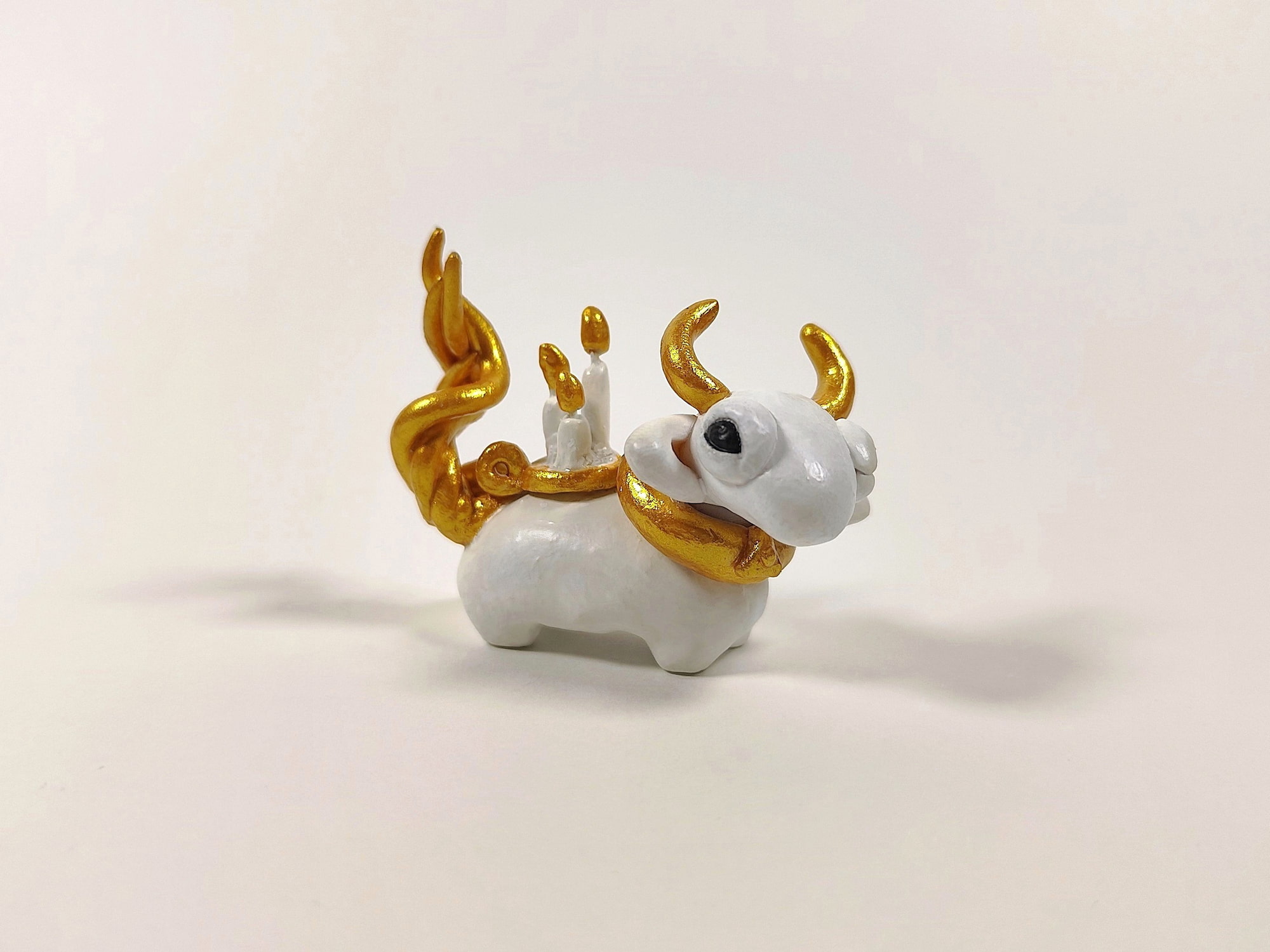
The Bull of the Sacred Fire
Blanca de la Torre
Polymer medium and acrylic paint.
5 x 6.5 x 3 cm.
2026
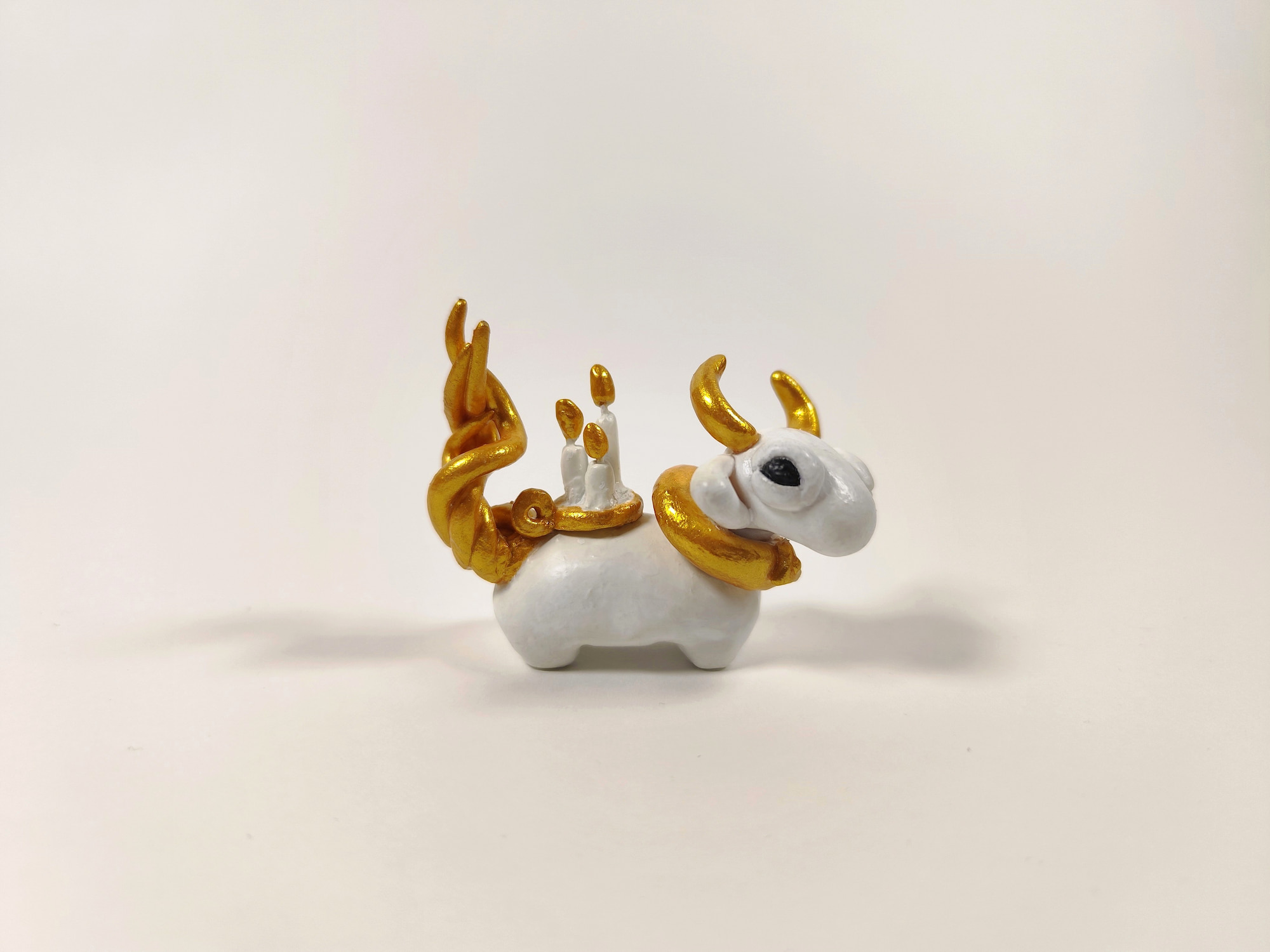
"Fire dwells upon the spine of the calm beast.
The flame demands conscious custody in a present of LEDs and screens.
The bull, bearer of light, has turned white to become a rite in motion."
The Bull of Sacred Fire
Conceptual Rationale and Proposition
The Living Altar and the Semiotics of Fire
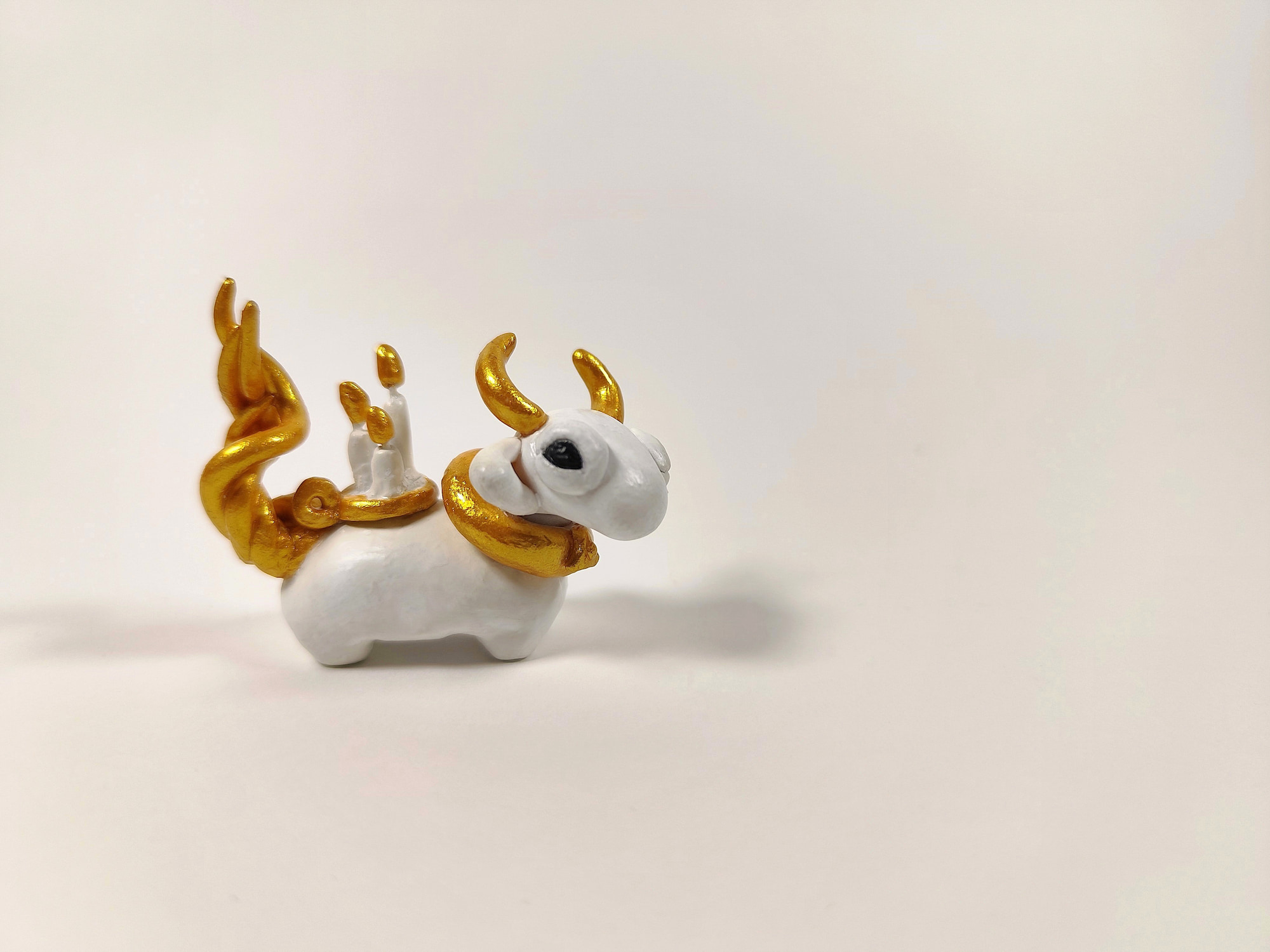
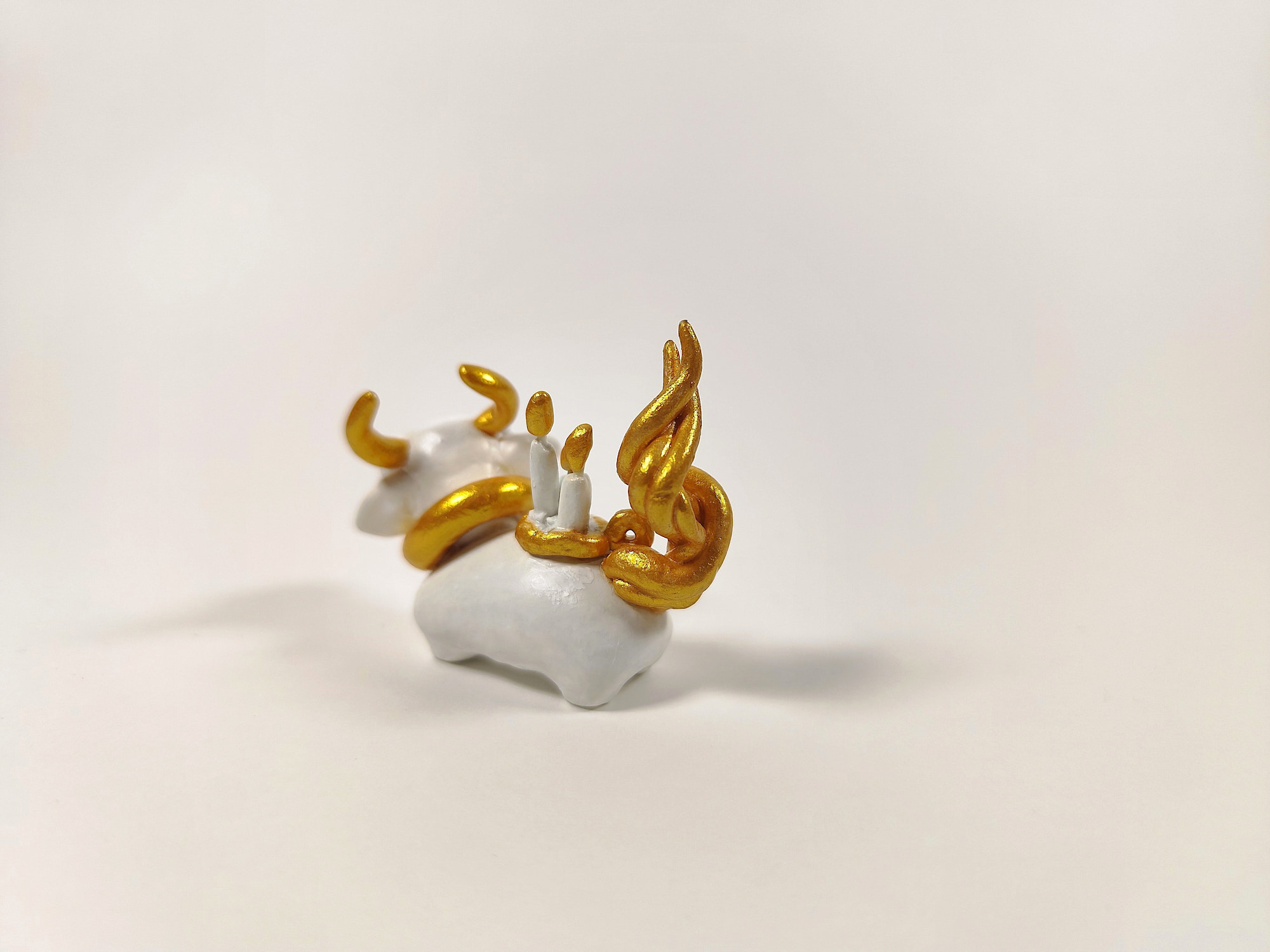
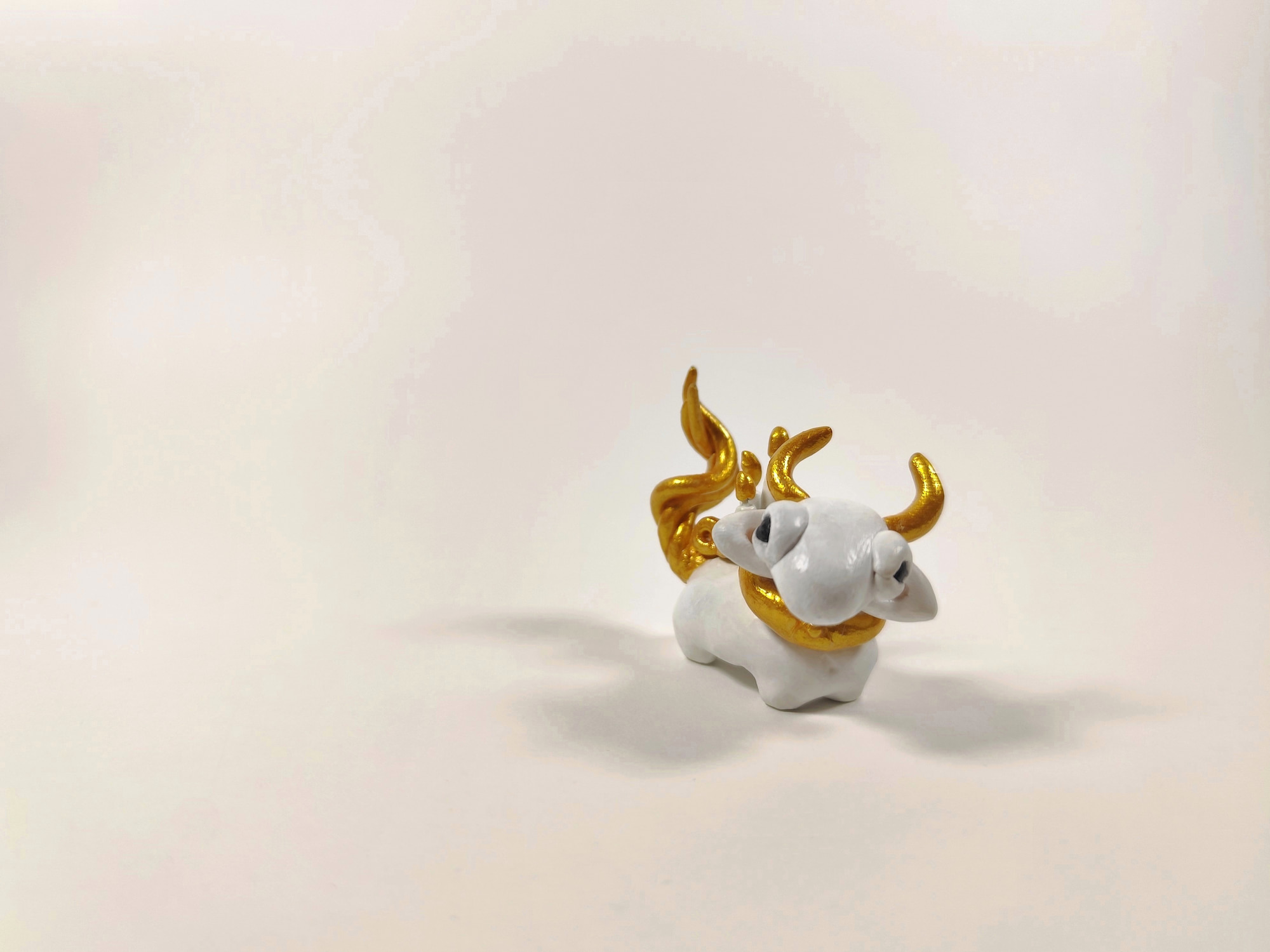
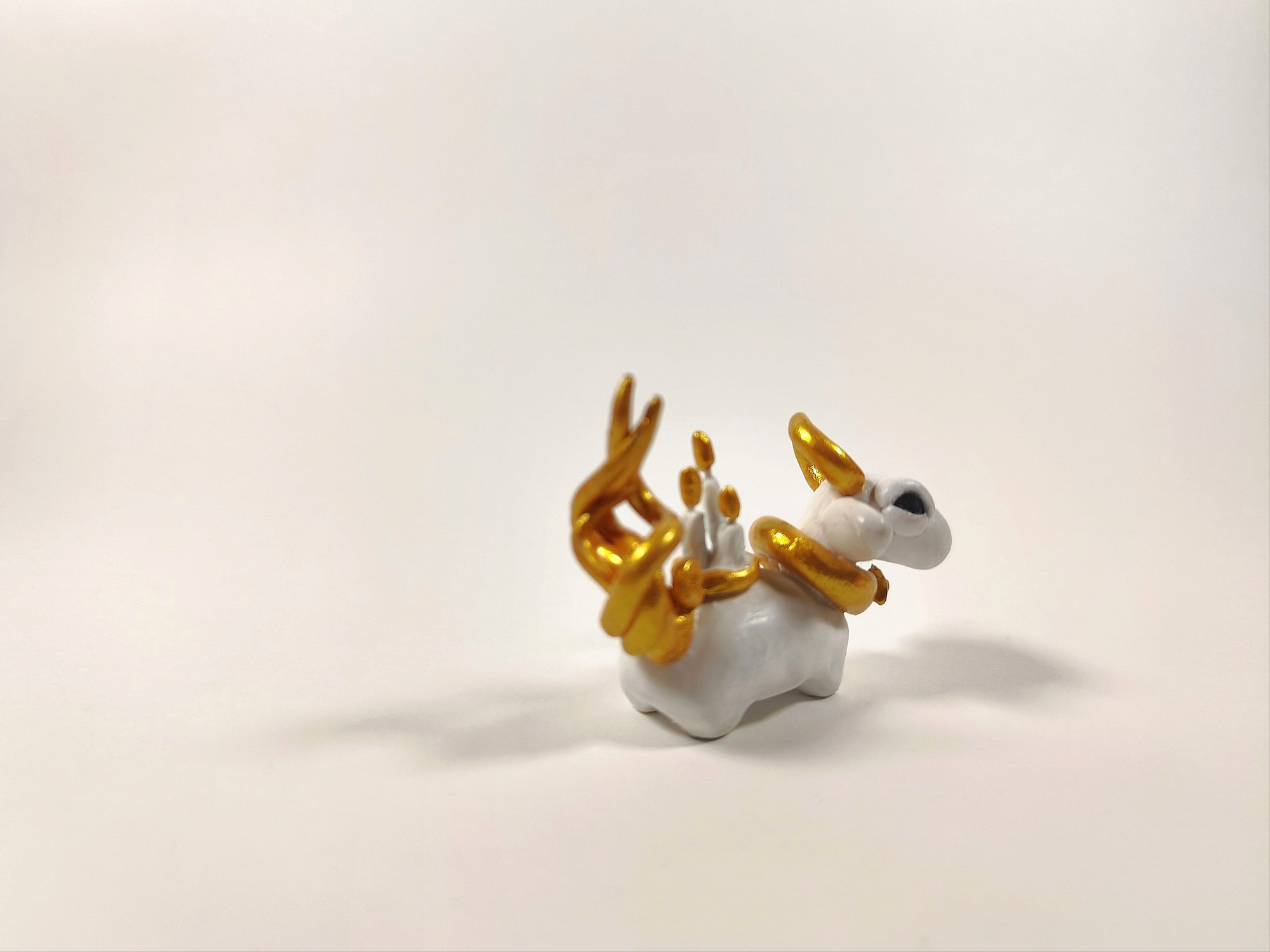
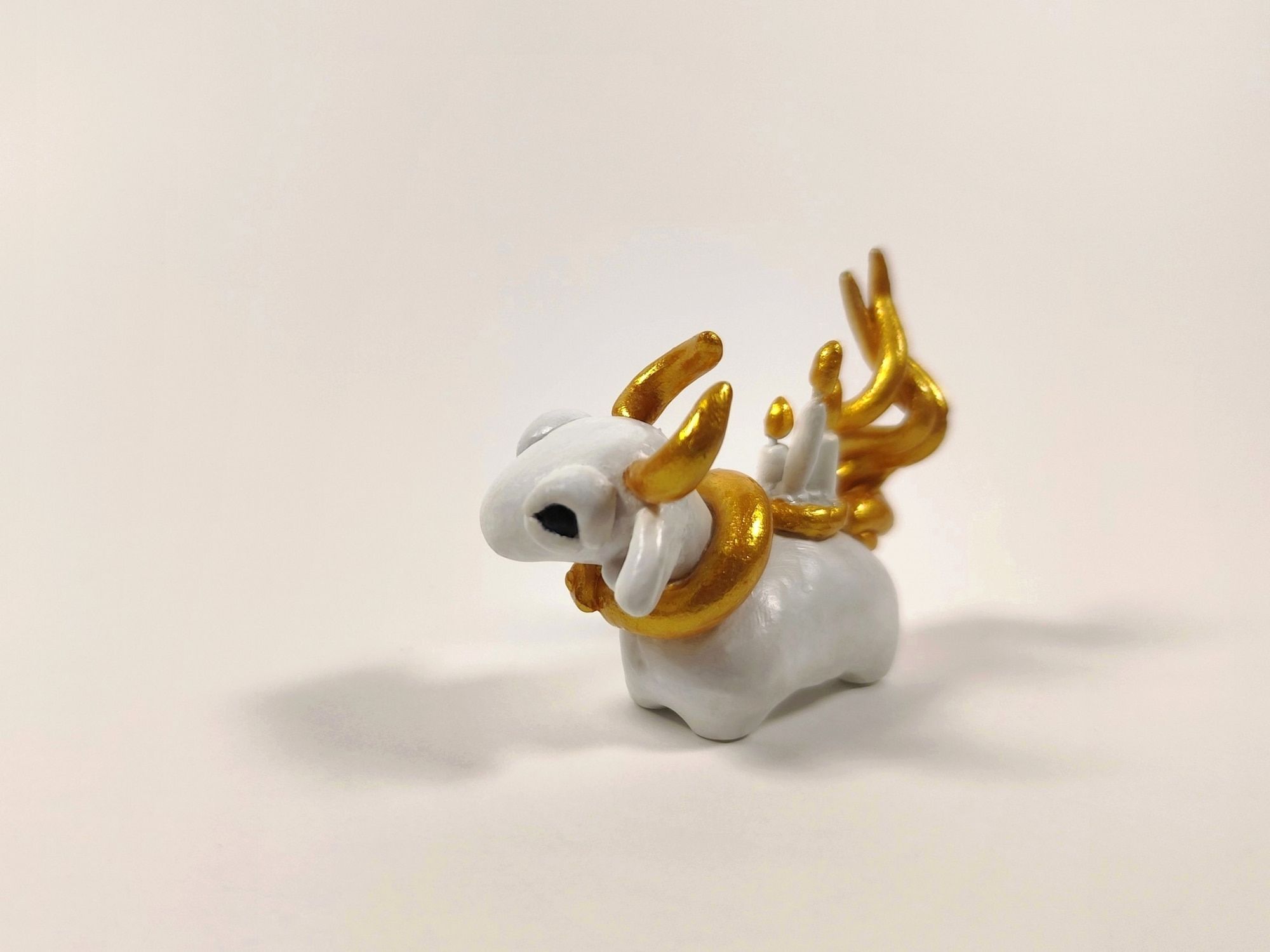
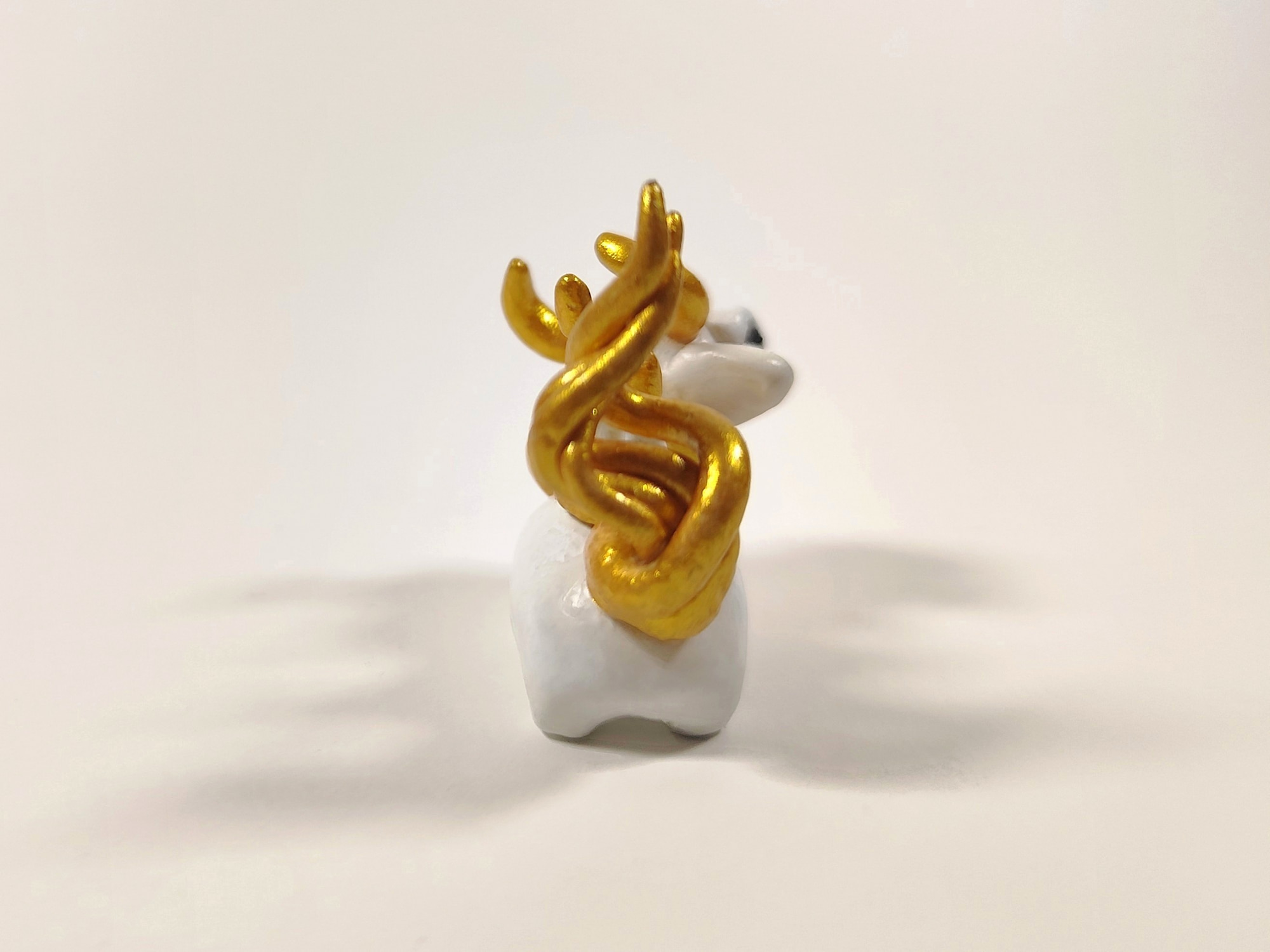
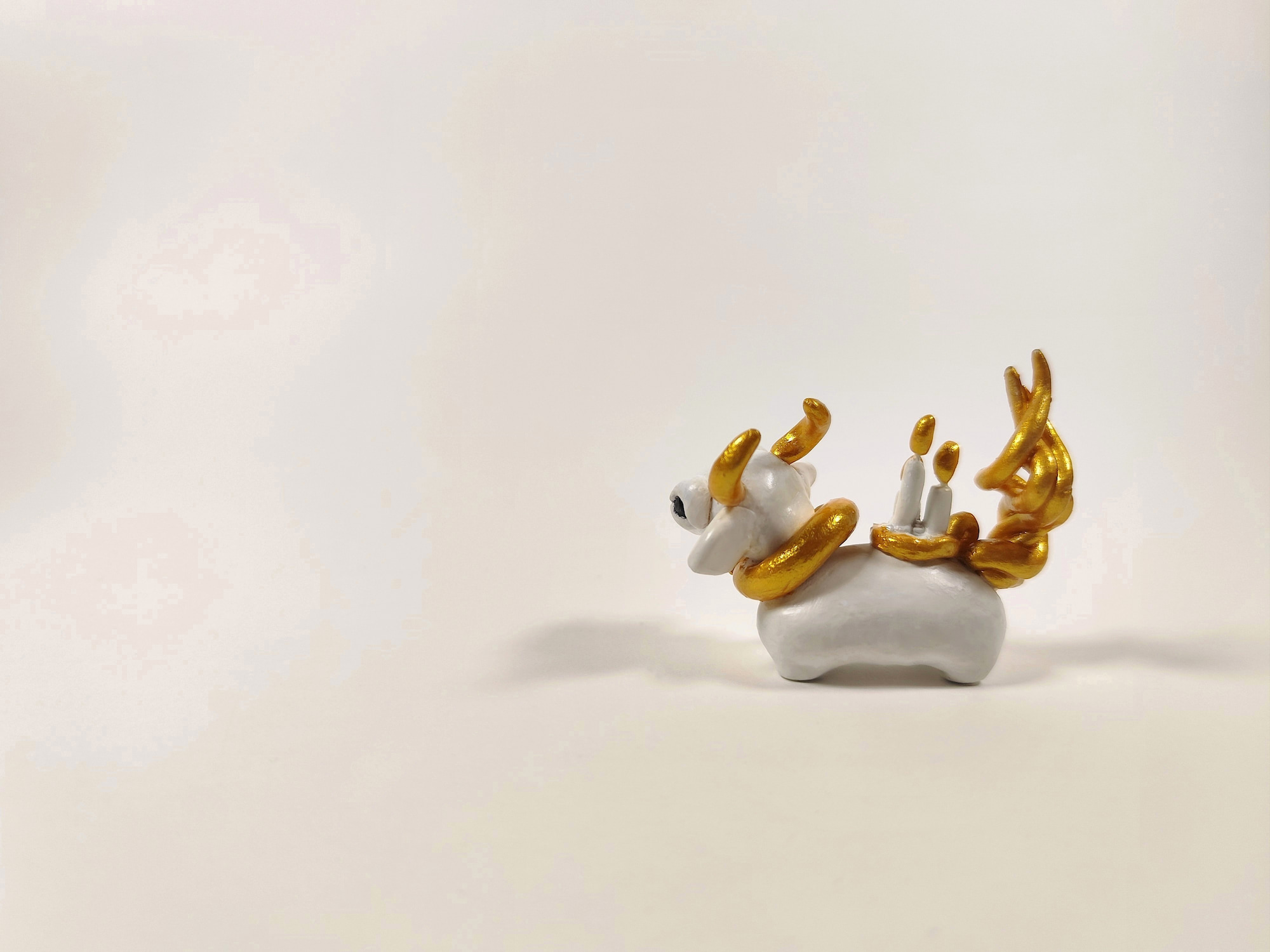
This sculptural proposal offers a reinterpretation of the taurine archetype through the integration of ritual fire iconography and solar luminosity. By means of a quadrupedal figure with soft volumes and a smooth white surface, the piece incorporates within its anatomy a series of gilded attributes of marked symbolic density: golden horns emerging with ascending force, a ceremonial collar around its neck, a gilded candle holder with three candles positioned on its back, and a tail that coils upward to become a sculpted flame. The work shifts the classic association of the bull with ferocity or brute strength to reconfigure it as a portable reliquary, an altar-animal that holds the flame and prompts a reflection on the preservation of poetic energy, attention, and memory within contemporary artistic practice.
I. The Genealogy of the Solar Bull and the Transfiguration of Fire
In the mythologies of Mediterranean and Eastern antiquity, the bull has embodied the primordial force of nature, telluric fertility, and solar symbolism. From the cult of the Apis bull in Pharaonic Egypt to the tauroctony in the Mithraic mysteries, the taurine entity has historically been linked to the dynamics of sacrifice and consecration at the altar.
However, this sculpture executes a conceptual turn in the narrative of the myth. The animal is no longer the victim destined for immolation nor the destructive monster demanding vassalage. The piece draws upon the matrix of the solar bull to transform it into a conscious bearer of fire. Opposed to the traditional Promethean paradigm, in which fire represents a cleverly stolen technique generating tragic conflict and a rupture with the divine, the sculpture proposes a semiotic reconfiguration: the flame is not a furtive spoil, but is carried openly and balanced upon the spine of the creature. The Promethean myth thus shifts from guilt toward a pedagogy of custody, care, and intellectual responsibility. By integrating the gilded candle holder with its three candles and the igneous tail into its own corporeal mass, the work proposes a reconciliation between the biological force of the beast and the aesthetic, formal dimension of fire, suggesting that ritual energy operates as a self-referential symbolic system rather than an act of external consumption.
II. Chromatic Alchemy: The Vulnerable Body and the Golden Crown
The formal strategy of the piece is articulated through a bidirectional contrast between the polished whiteness of the body and the metallic sheen of gold. The corporeal mass of the bull dispenses with hypertrophied musculature or aggressive traits; its short legs, compact torso, and dark eyes with a serene gaze bestow upon it a quality of vulnerability and innocence. This white body acts as a primary canvas, a neutral container pointing to the phase of albedo in alchemical hermeneutics, understanding this stage of whitening as a process of physical clarification, washing away material impurities, and neutralizing primary telluric chaos.
This economy of form and chromatic neatness enters into conceptual dialogue with the Eastern parable of the Ten Oxherding Pictures in the Zen tradition. In that visual narrative, the gradual lightening of the animal's coat until its absolute whiteness symbolizes the taming of brute force, the plastic purification of language, and the containment of mental dispersion. The whiteness of the bull does not deny its instinctive nature, but displays the result of this albedo and of a rigorous process of formal synthesis. In contrast, the presence of gold embodies the final stage of alchemical transmutation, denoting that which is incorruptible, permanent, and ageless. The horns curving upward do not function as weapons for charging, but as vectors that capture and channel solar radiation. The thick collar encircling its neck highlights its status as a consecrated being, marking the boundary between the earthly body and the head endowed with symbolic perception. Finally, the tail, spiraling upward to mimic the morphology of a live flame, unifies the vertical composition of the piece and projects the energy of the animal into the upper realm. The visual interplay between the immaculate body and the gold accents reproduces the logic of the alchemical Magnum Opus: the elevation of base matter from the receptive purification of albedo to the luminous fixity of gold as the supreme sign of knowledge and permanence.
III. The Inversion of the Altar: The Gilded Candle Holder and the Disarticulation of the Sanctuary
The central element of the composition resides in the device set upon the back of the bull: a gilded candle holder from which three white candles with golden flames emerge. This structure converts the anatomy of the creature into a portable altar or ritual focal point. In cultural anthropology, the piece recovers the concept of Vahana, the animal vehicle or somatic support in Asian traditions, reinterpreting it as a sculpture-support. The bull is not a mere figurative representation, but the biological platform and indispensable physical substrate holding the symbolic artifact.
Historically, cultic fire demanded a fixed location within a temple or institutional space, as seen with the sacred fire of Vesta in classical Rome. By placing the candle holder upon the anatomy of the animal rather than a static ceremonial pedestal, the sculpture disarticulates the rigidity of the traditional place of worship. The three candles suggest a triadic structure: past, present, and future, or the synthesis of thought, intention, and expression. The creature does not suffer under the weight of this support; it bears it with poise and stability in its calm posture, assuming the role of custodian to this symbolic focal point. This severance from fixed architecture suggests that the preservation of the fire of thought and creation does not depend on permanence within a formal temple, but on the conscious sustenance and personal custody of core ideas throughout existential transit.
IV. The Mutation of Ancient Symbolism and the Phenomenology of Contemporary Light
In contemporary visual culture, the daily experience of lighting is dominated by optoelectronic devices, cold-temperature LED emissions, and the constant glare of digital interfaces. In this setting, the sculpture introduces a physical manifestation of light grounded in the material density of the sign. The piece does not appeal to the physical fire of active combustion, but to the petrification of the flame as a sculpted Sign, turning the idea of combustion into a sculptural and iconographic stratification.
The gradual displacement of direct fire away from the domestic environment has substantially altered the relationship with the flame. Although igneous matter has historically constituted an archetype of marked power, sacredness, and transcendence since ancient civilizations, the loss of its routine presence in practical life has heightened its perceptive impact in a singular way. As it becomes an unusual phenomenon within current technological routine, the symbolic force of the flame intensifies, acquiring an atavistic and extraordinary character of high ritual density that reactivates the presence of material light.
Thus, the piece is articulated within the current context as a focal point of somatic, localized, and measured luminosity. The candle holder placed upon the creature's back evokes that primordial presence, establishing a distinct expressive nuance against the saturation of industrial lighting technology. In this manner, the work marks a turning point in the phenomenology of contemporary light, wherein the sculptural object translates the codification of the flame into a device for silent contemplation and concentrated attention within the visual landscape of today.
V. Formal Synthesis and the Presence of Fire in Contemporary Space
From the perspective of formal construction, the sculpture stands out for the synthesis of its lines. Manual modeling preserves subtle organic variations that emphasize the tactile quality of the object. Likewise, the contained tension of its forms and its intimate scale in workshop format heighten the perception of an object meant for private contemplation, an effect reinforced by the subtlety of its gold accents.
Presented within the neutrality of the white cube, the piece generates a poetic counterpoint to the secularized contemporary environment. The bull does not impose itself through aggression, but through the radiation of a contained warmth. In this way, the work rises as an allegory of introspection and intellectual resistance, reminding the viewer that the custody of light does not require grand temples, but an attentive and preserved presence at the core of thought.