
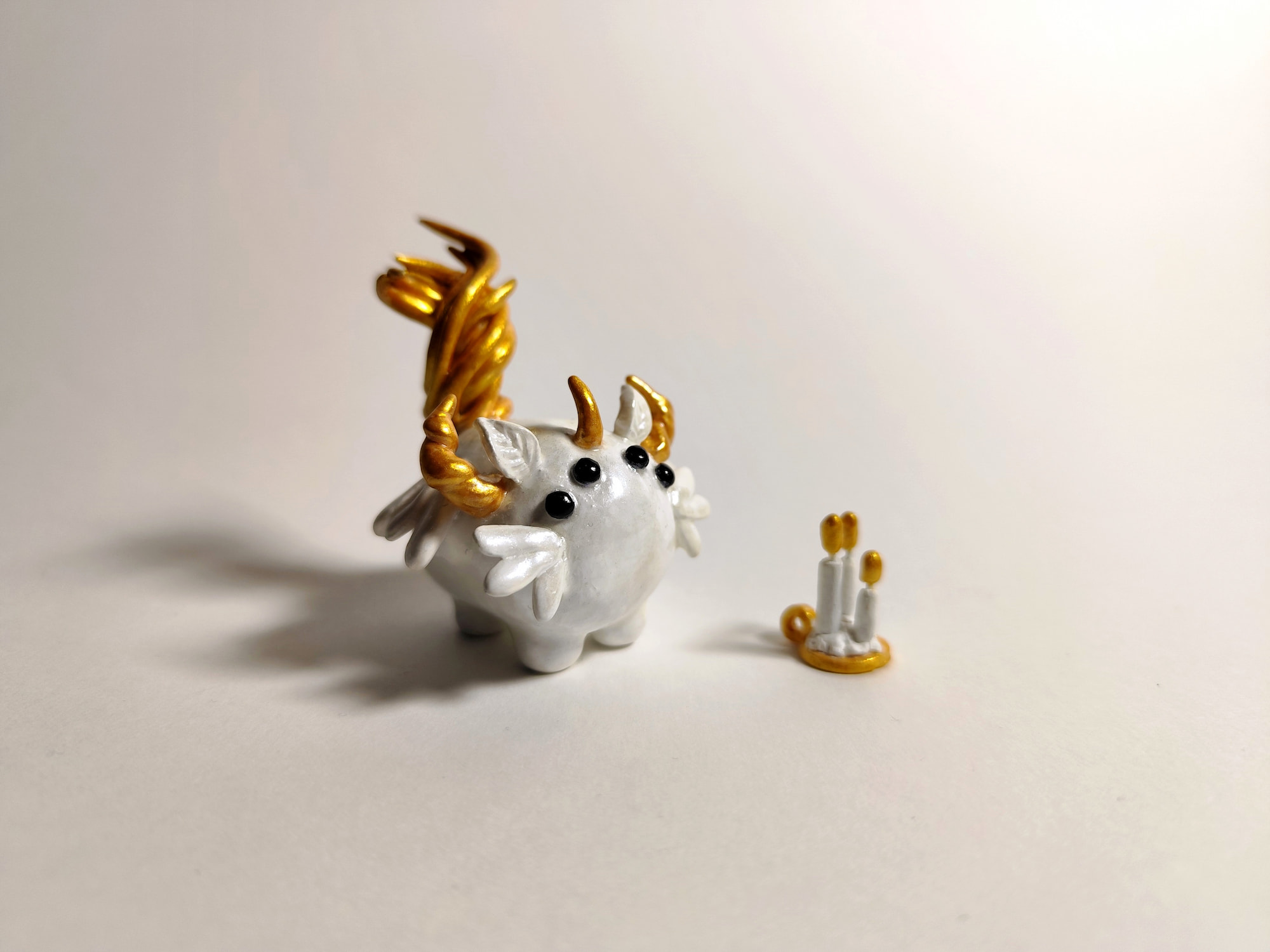
Polyophthalmia
Blanca de la Torre
Polymer medium, acrylic paint, and aluminum armature.
Two-piece installation. Piece 1: 9 x 5 x 4.5 cm; Piece 2: 2.2 x 1.7 x 0.9 cm.
2026
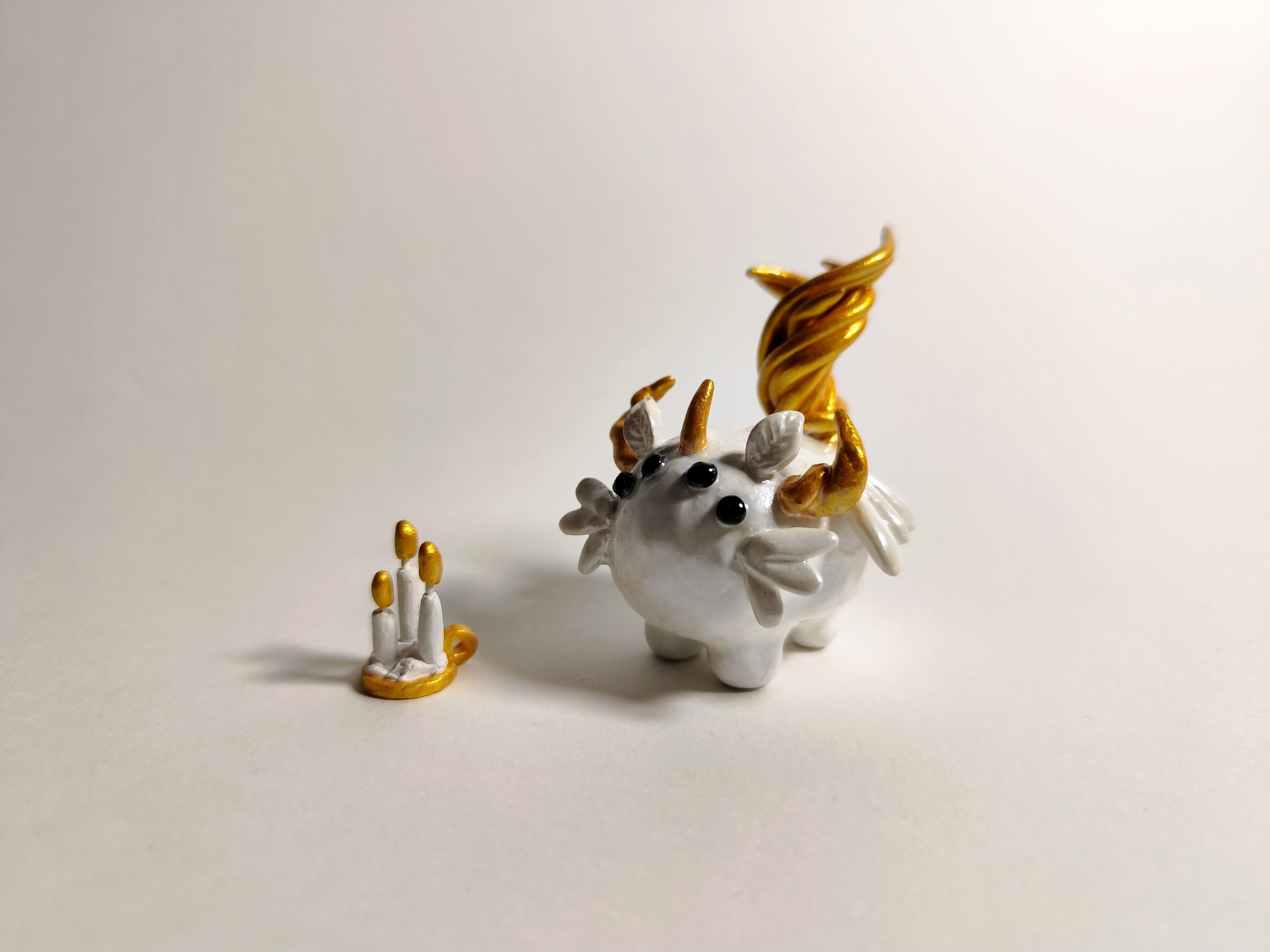
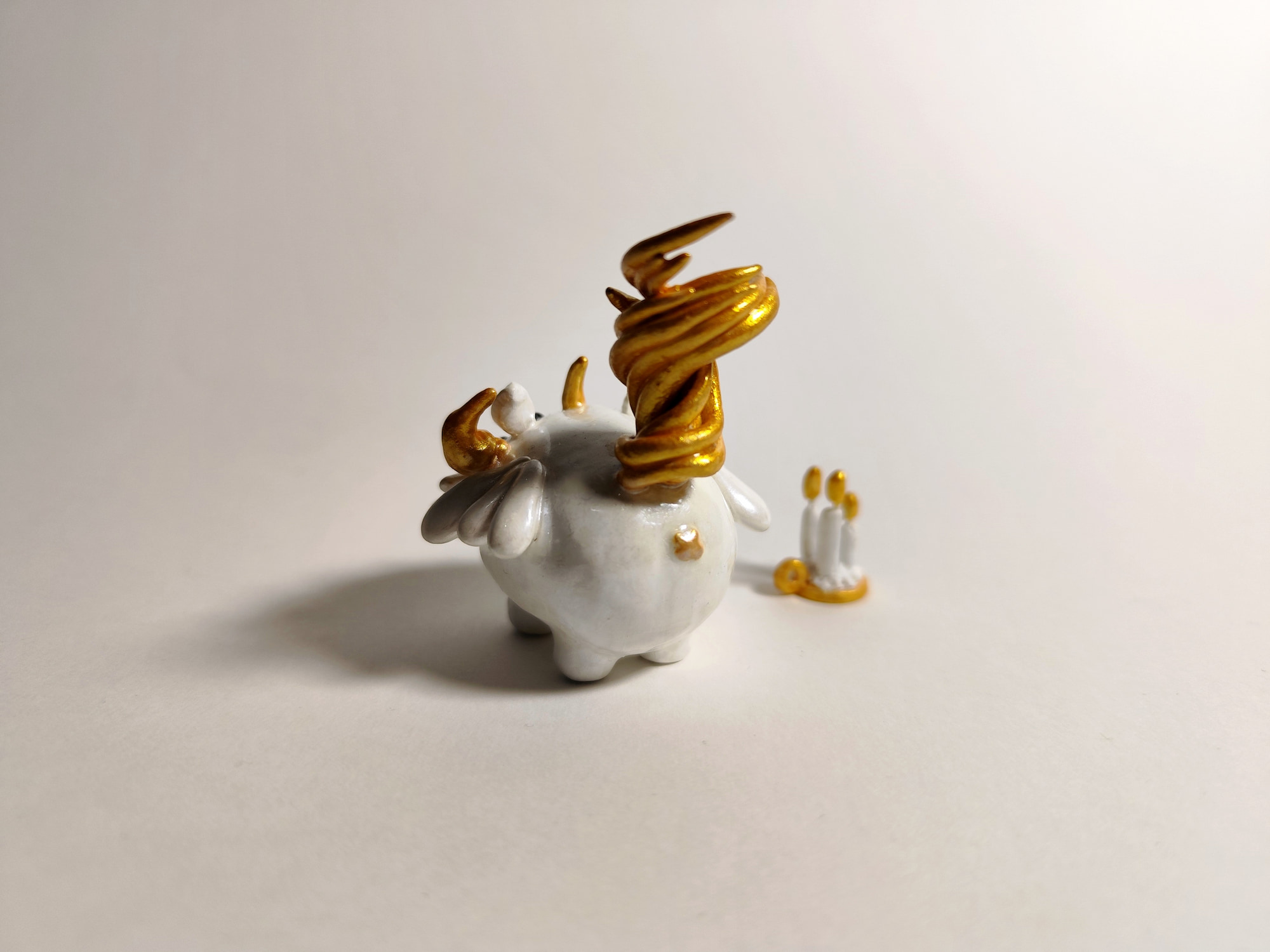
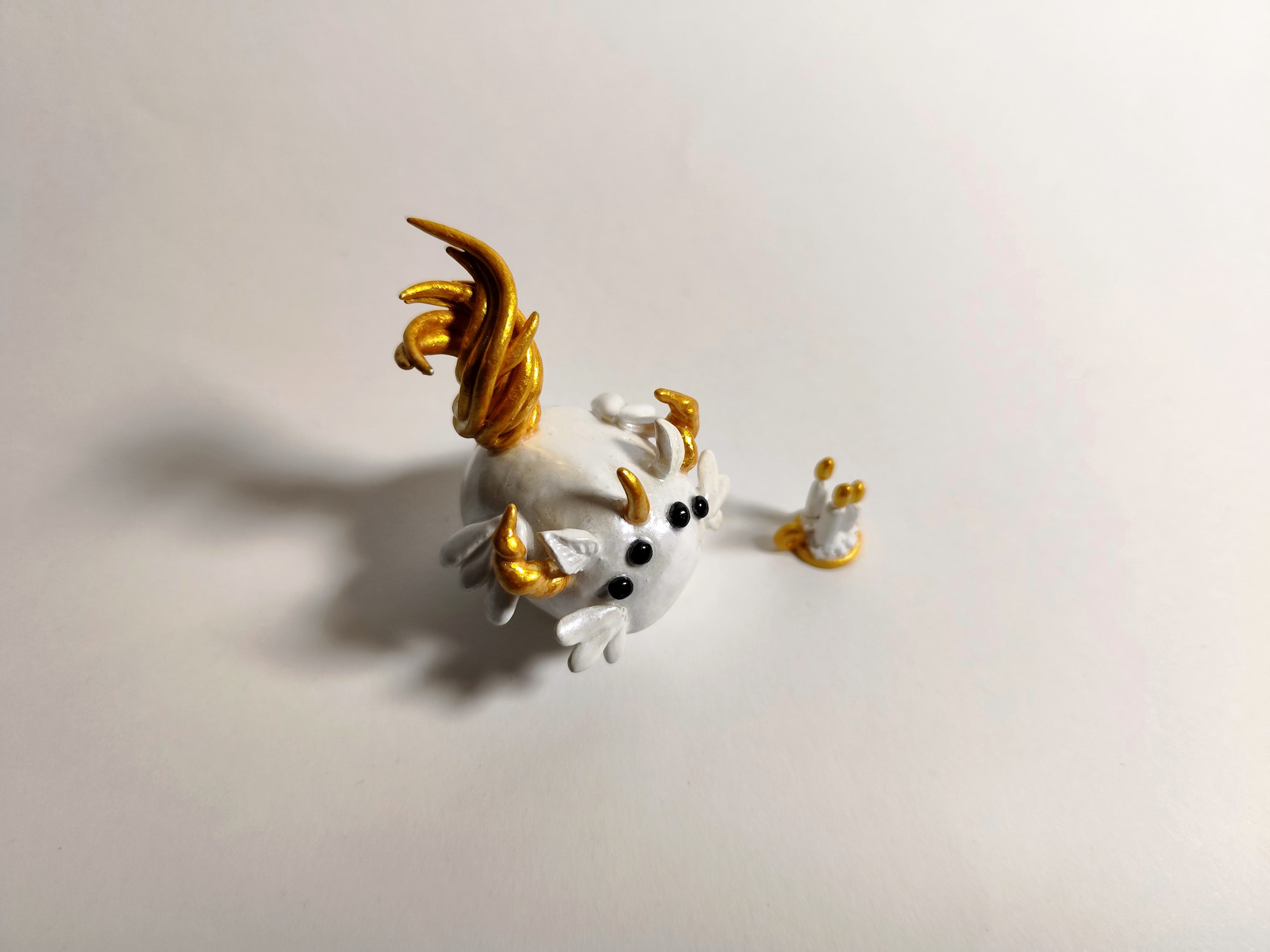
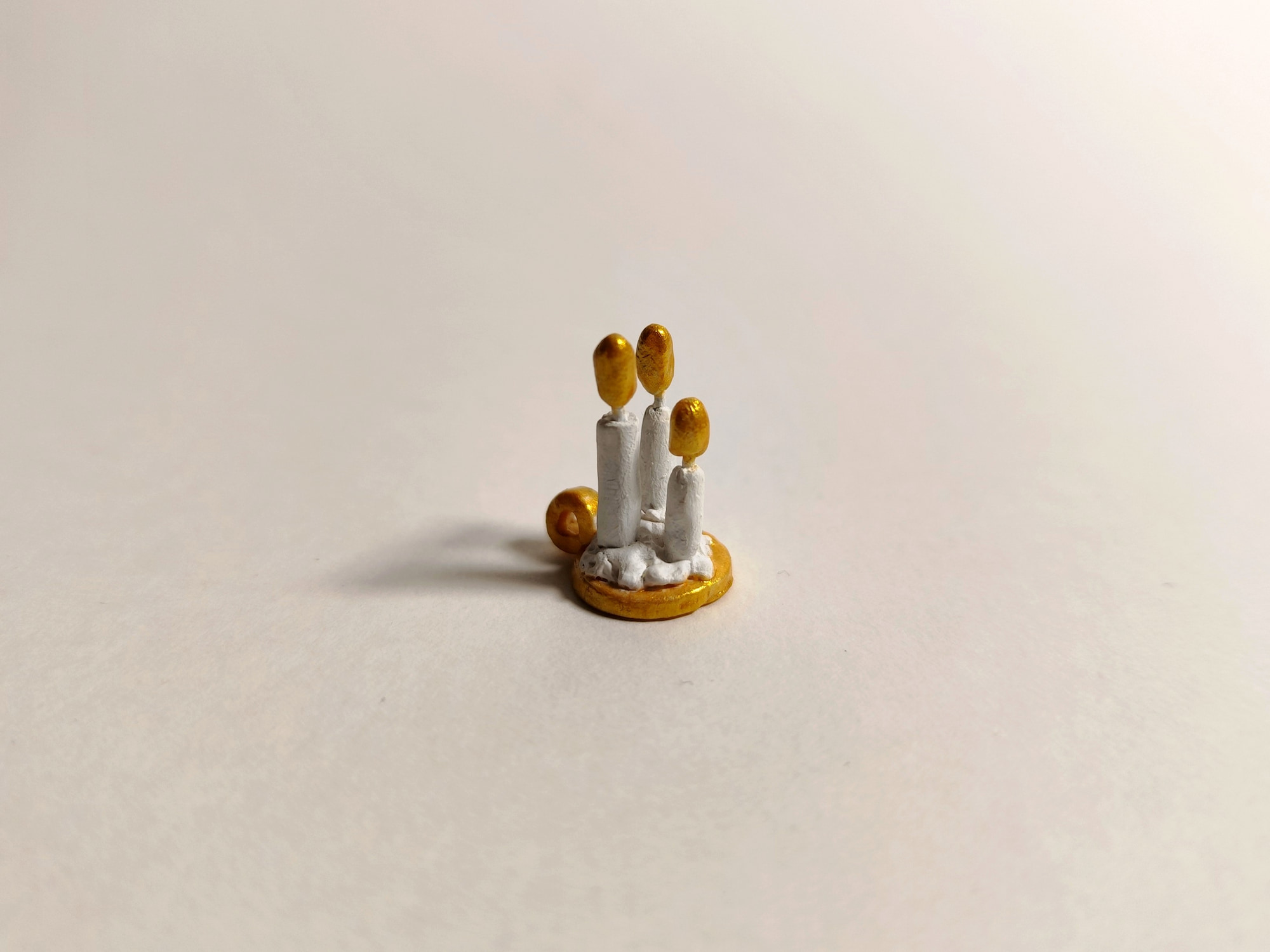
"The multiplication of the gaze dismantles the single focal point to project a fourfold perception.
In the quietude of polished volume and gilded paint, matter moves through its phases, transforming the flame into an instrument of inner vision."
Polyophthalmia
Conceptual Rationale and Proposition
I. Genealogy of the Multiplied Gaze: Comparative Iconography and Quaternary Geometry
In the history of three-dimensional representation, the abundance of visual organs within a single entity constitutes an iconographic resource of high theoretical density. Far from any teratological reading, Polyophthalmia approaches the multi-eyed figure as guardian and companion to the three flames, framing an investigation into attention, the organization of the gaze, and the function of guardianship in visual culture.
The artwork structures its visual field through a grid of four dark, lustrous eyes across the creature’s face. In formal theory, quaternary structure embodies the archetype of wholeness and analytical completeness, articulating the four axes of perception and thought. This quaternary geometry shifts away from the single focal point of traditional perspective, offering instead a distributed mode of reception that transforms the entity’s face into a fourfold locus of attention.
This formal approach enters into direct dialogue with comparative mythology and the history of religions. The quintessential classical reference is Argus Panoptes, the hundred-eyed giant whose unwavering vigilance was immortalized when Hera transferred his pupils to the peacock’s tail, transmuting the guard's paranoia into an ornamental display of pure contemplation. Similarly, the Judeo-Christian tradition articulated in Ezekiel’s visions the figure of the Ophanim or Galgalim, the living wheels covered in eyes that guard the divine throne through an immediate apprehension of the cosmos's structure.
In Eastern traditions, Mahayana Buddhism venerates Avalokiteshvara in the manifestation of Sahasrabhuja, the thousand-armed bodhisattva with eyes embedded in every palm, where the gaze joins action to relieve suffering. Concurrently, in Hindu mythology, King Indra's biological curse turns into an attribute of wisdom as a thousand incisions on his skin become perceptive eyes, a motif of omniscience echoing the Purusha of the Rig Veda, the primeval entity whose thousand eyes behold the entirety of existence. Polyophthalmia synthesizes this vast lineage of the multiplied gaze, transforming ocular profusion into an aesthetic device that restores to viewers a heightened awareness of their own presence.
II. Anatomy, Alchemy, and Corporeal Cohesion: From Nigredo to Albedo
From the standpoint of bodily articulation, the sculpture establishes a rigorous counterpoint between the white mass of its form and a series of accents in gold paint. The spherical torso, resting on four short limbs that grant it a stable, grounded presence, draws on the polished whiteness of the alchemical albedo. This stage of the work in white signifies the purification of matter, the clearing away of raw projections, and the arrival of a serene form. Flanking this translucent volume are folds and small wings with smooth white surfaces that lend a delicate, archaic physiology.
Rising from the head are three horns rendered in gold paint that serve as vectors of intellectual discernment, while the tail curves upward in a vertical projection shaped like a flame. This fiery tail connects directly with the Mesoamerican myth of the Tlacuache, the culture hero who, much like Prometheus, stole fire from the gods by carrying it on his own tail, and invokes the hermetic archetype of the salamander, the creature that in medieval bestiaries and Paracelsian alchemy embodies the elemental of fire, capable of dwelling within the flame without being consumed. This mythical, igneous lineage dialogues in turn with contemporary pop culture, where the fiery tail seen in creatures such as Red XIII or Charmander signifies the creature's vital force and inner fire.
This structural articulation forms a deep bond with alchemical symbolism. In classical thought, achieving the albedo did not deny the nigredo; rather, it recognized the initial stage of chaos and primary matter as the indispensable root of transformation. Through this lens, the X-shaped incision coated in gold paint on the rear side functions as a discreet seal that acknowledges and embraces the hidden. It suggests that true understanding requires integrating the less visible reverse of things; in line with the Jungian concept of the shadow, denying uncomfortable or rejected aspects, rather than observing and integrating them, prevents the development of a complex perspective, standing in the way of maturity and collective progress in society.
III. The Candelabra Stage: Fire as Inner Vision and Contemporary Mythography
The second component of the ensemble, a freestanding miniature candelabra with a circular base and handle finished in gold paint, holds three white candles topped with sculpted golden flames. This element creates a spatial dialogue between two modes of perception: the external gaze of the multi-eyed body and the inner vision embodied by light.
Throughout the history of art and symbolic form, fire has signified the awakening of intellect and self-awareness. This lineage stretches from the cult of Vesta in ancient Rome, where priestesses guarded the sacred flame to ensure civic and spiritual continuity, to the reverence of sacred fires across many cultures. By physically detaching the creature from the candelabra, the sculpture establishes that the source of light is not a passive biological trait, but an object of conscious guardianship entrusted to the attentive companionship of this multi-eyed being.
The three candles with fixed flames in gold paint invoke the structure of endogenous contemplation. This motif of the small flame as a guide through darkness runs through visual iconography, from Arcanum IX of the Tarot, The Hermit, who steps into the dark holding a lantern, to the narrative world of contemporary video games. Examples such as Six’s journey in Little Nightmares, navigating oppressive spaces armed with a small lighter, the bonfires in Dark Souls serving as sanctuaries of sanity amidst dissolution, or the survival mechanics of Don't Starve, where light is the sole defense against dark forces, demonstrate the enduring power of the flame as a locus of mental resilience. The sculpture's petrified flames convert ephemeral combustion into an enduring sign, offering a point of stillness against the cold glare of digital screens.
IV. The Infrastructure of the Gaze: Surveillance, Cameras, and the Sculptural Response
In contemporary visual culture, the multiplication of eyes has shifted from a mythological allegory into the everyday architecture of the urban landscape. Today’s panoptic network operates not through a single watcher, but through millions of security camera lenses, biometric sensors, handheld devices, and facial recognition algorithms that continuously record, archive, and quantify imagery. The ubiquity of digital tracking has established a state of mandatory visibility where every movement is potentially recorded.
Polyophthalmia stands as a critical disruption to this infrastructure of extractive surveillance. Unlike modern cameras that consume their surroundings to turn them into data and metrics, the four dark eyes of the creature enact a gaze that refuses the logic of capture; they observe not to quantify, but to redirect attention back toward the personal and the interior realm. Its jet-black pupils and deep luster function as filters of absorption and reflection, offering a tactile presence that does not extract the viewer's image, but instead hands back the consciousness of looking.
Faced with digital acceleration and immateriality, the work asserts the physical weight of the three-dimensional object. Its intimate scale slows the viewer's pace, inviting closer proximity and encouraging quiet, sustained observation. In doing so, the sculpture marks a turn in contemporary perception: the multiplicity of eyes ceases to act as an instrument of control, becoming instead a catalyst for contemplative pause, introspection, and perceptual suspension.