
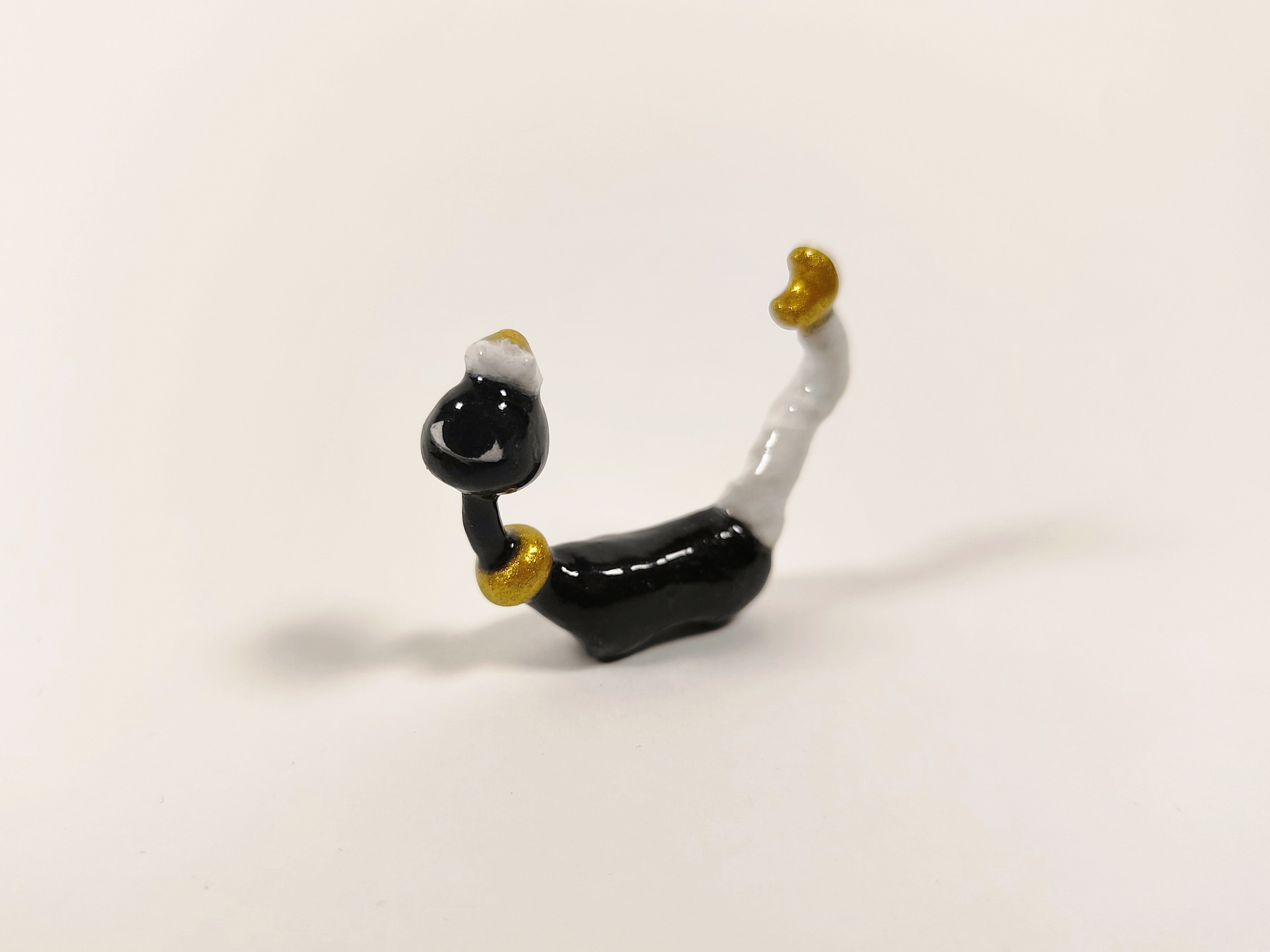
The Cyclops of Shadow and Night
Blanca de la Torre
Polymer medium, epoxy resin, and acrylic paint.
3.2 x 4 x 1 cm.
2026

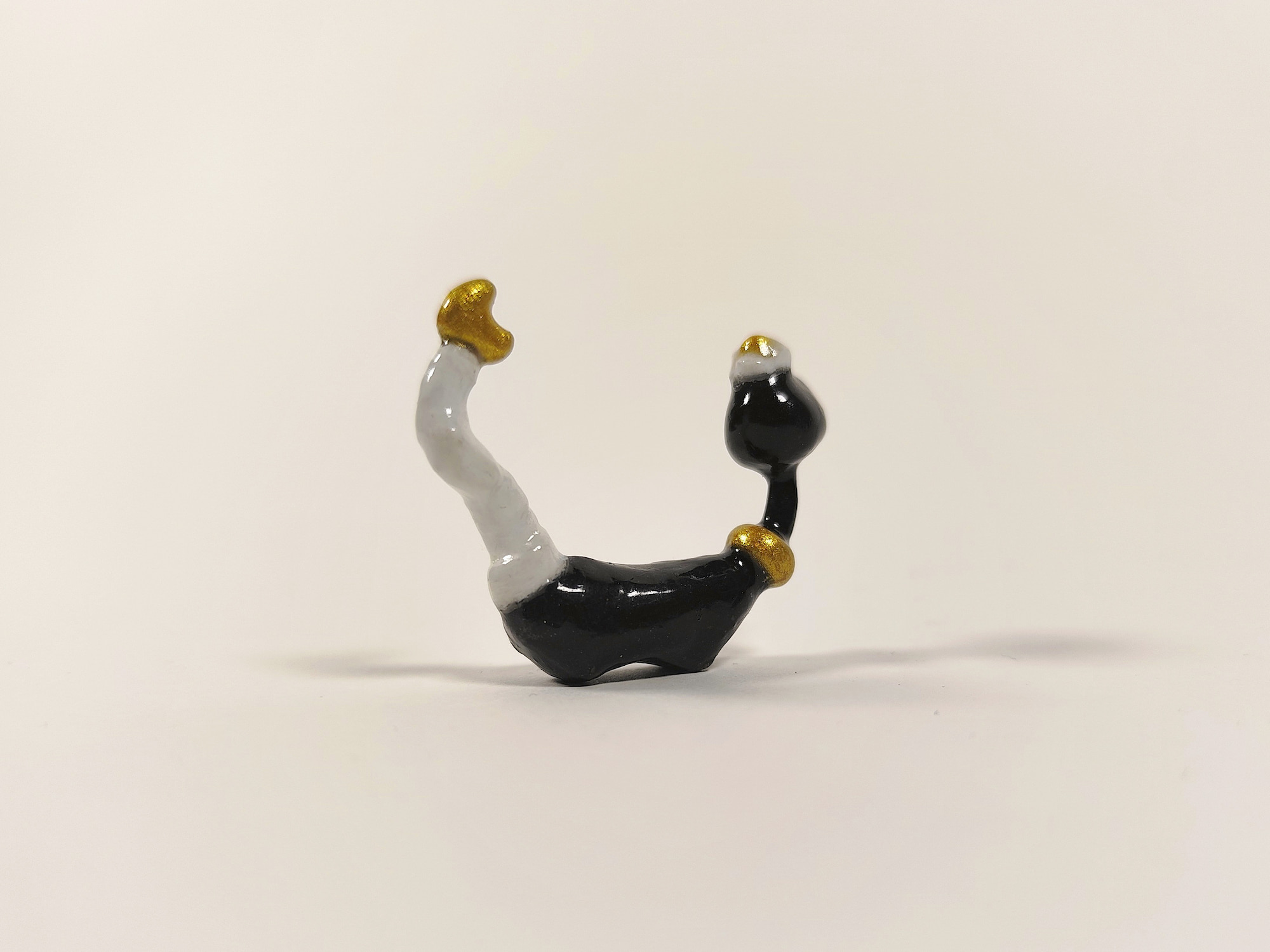
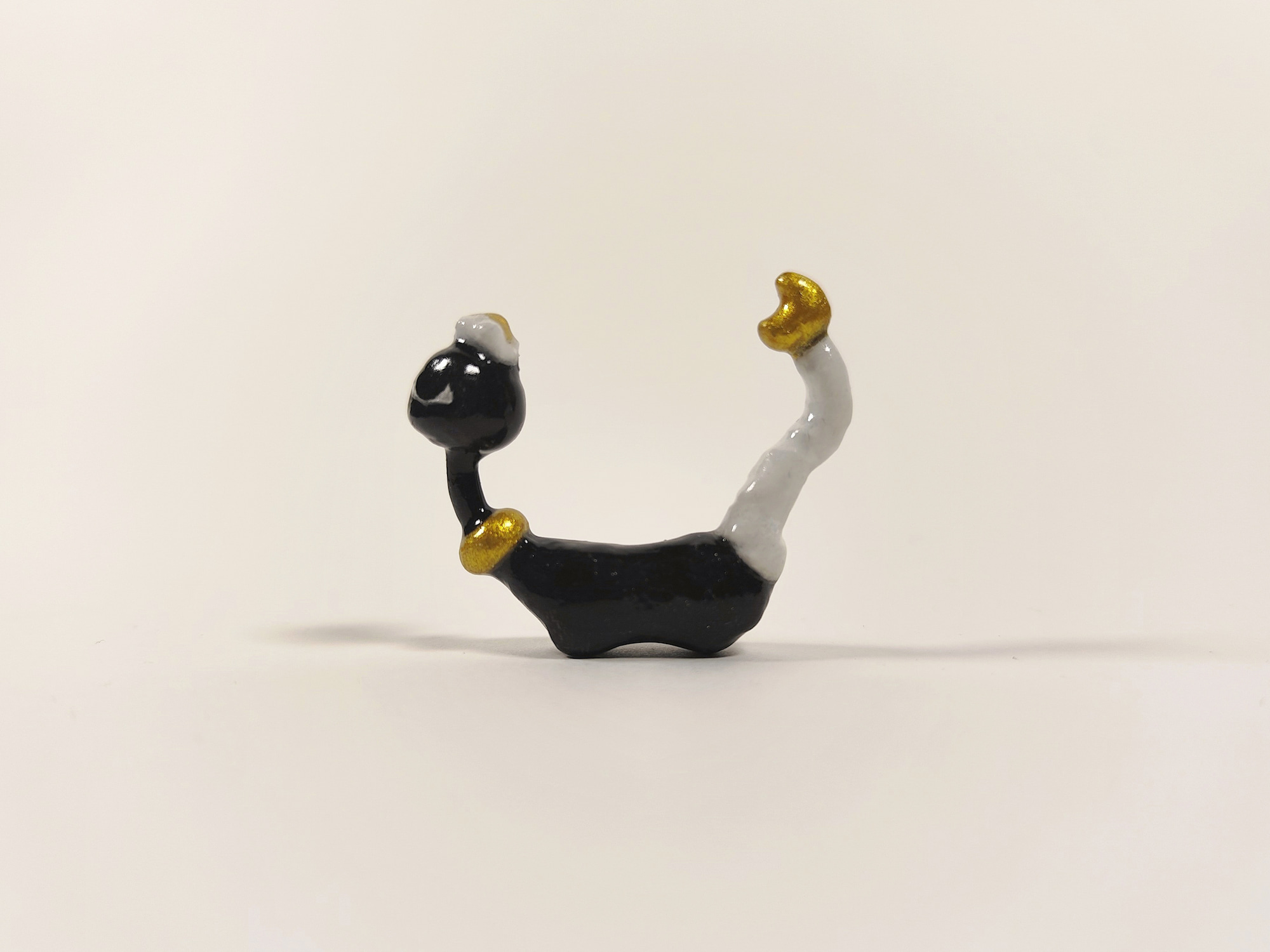
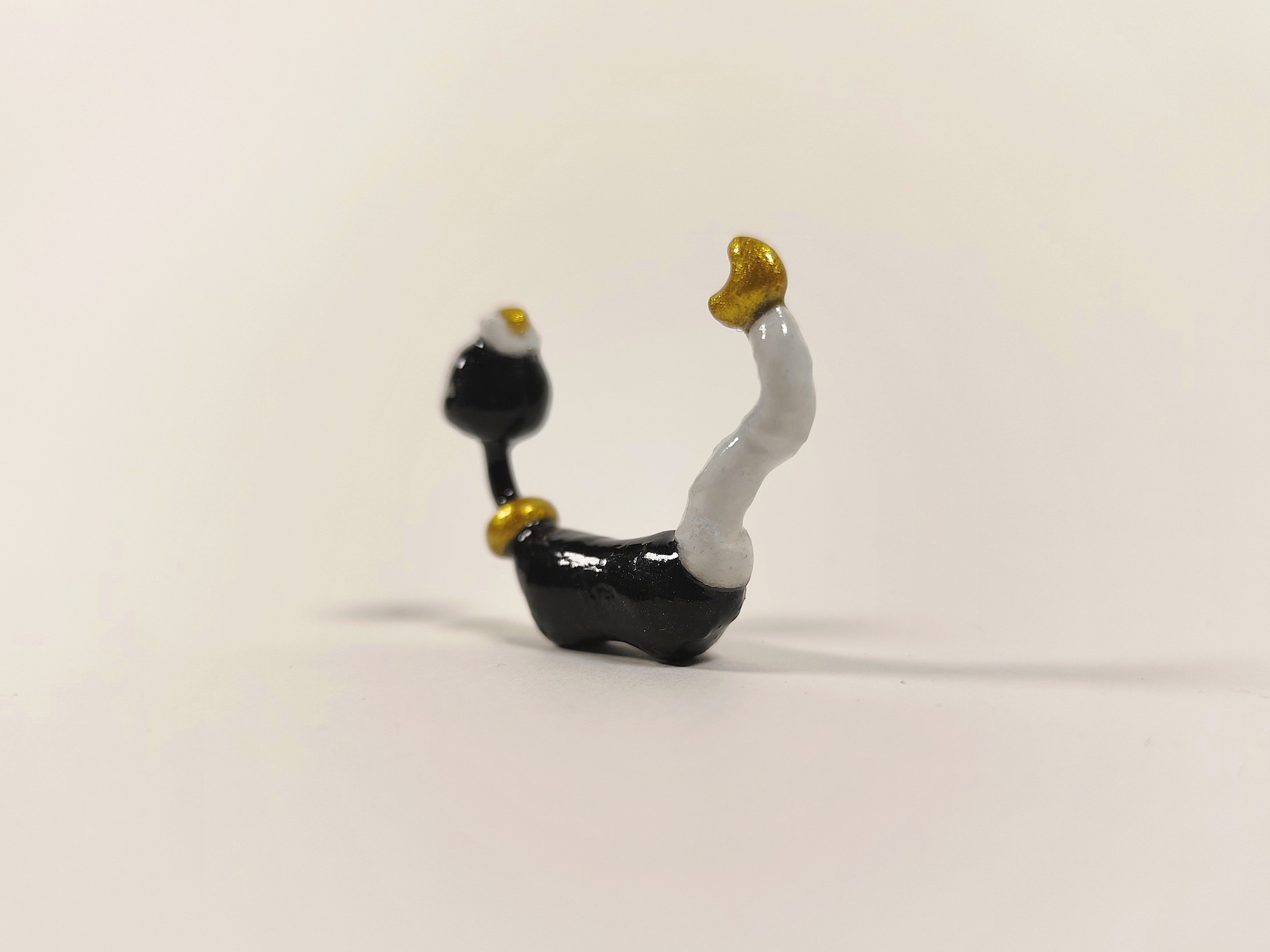

"The cyclops forged from night: a departure from dualism in search of a unity where intellect and instinct merge.
Holding the gaze toward one's own Shadow as the sole path inward."
The Cyclops of Shadow and Night
Conceptual Rationale and Proposition
I. The Monocular Gaze
The Cyclops of Shadow and Night centers its formal strategy on the absolute prominence of a head conceived entirely as a single, vigilant eye. This element operates as an instrument of internal perception, a unified lens that pierces and interrogates the realms of subjectivity where conventional logic falls away.
Analytically, the dark torso embodies the dimension of the Shadow, aligning with the initial phase of transformation known within the alchemical tradition as nigredo: a state of density and primordial chaos in which instinctual drives coexist without an established order. Confronting this darkness is essential for the structuring of the self. Throughout cultural history, the single eye has carried a dual resonance: on the one hand, representing raw instinct and unbridled force, as seen in classical myth; on the other, signaling access to a deeper, unvarnished truth that transcends surface appearances. The work synthesizes this duality into an integrative vision. While ordinary binocular sight reinforces the separation between subject and world, monocularity here articulates the mind's capacity to reconcile opposites and bridge consciousness with instinct.
II. The Ring of Containment and the Perceptual Bud
The tension between the work’s opposing elements is mediated by metallic and organic accents placed deliberately along its form. A golden ring encircles the neck, establishing a precise structural boundary that separates the visceral energy of the torso from the cognitive function of the head. This formal gesture regulates the transition, preventing unconscious impulses from overwhelming the conscious structure and channeling raw nature through ordered spatial forms.
Just above the ocular plane, a stylized crest emerges, culminating in a radiant center. In symbolic lineage, this motif signifies evolution and complex thought rising from a dense substrate toward clarity. The piece employs this structure to reflect the process of individuation and psychological synthesis, with the golden core functioning as a stabilizing center for the self. It suggests that true clarity is not achieved by disavowing bodily darkness, but by building directly upon it.
III. Textile Containment and Transition Toward Clarity
A chromatic counterpoint to the dark torso appears at the rear, where the tail rises wrapped in a tactile white segment. This formal device symbolizes the containment of inner tension and marks the shift from the stagnation of nigredo to the phase of albedo, a stage defined by order, purification, and the reflective processing of unconscious material.
This white element is crowned by a golden crescent moon. Within the typology of forms, the moon represents receptivity and deep emotional states. Rendered in gold, it indicates that the volatile energy of the Shadow has been consciously integrated. What began as a chaotic impulse is thus transformed into a stabilizing force for the composition as a whole.
IV. Anthropology of the Single Eye in Cultural Tradition
Across religious history, comparative mythology, and global folklore, the single eye articulates a nuanced visual language that moves between untamed elemental power and the acquisition of sacred or prophetic insight. Partial sight or monocularity is rarely treated as a passive loss; rather, it serves as a ritual threshold or a prerequisite for apprehending realms hidden from ordinary human vision.
Greco-Roman tradition drew a clear distinction between two monocular archetypes. The Uranian or primordial Cyclopes (Brontes, Steropes, and Arges), offspring of Gaia and Uranus, were divine artisans whose central eyes concentrated the technical mastery required to forge Zeus’s thunderbolts, personifying elemental forces harnessed within the cosmic order. By contrast, Homeric narrative reframed the cyclops through Polyphemus as a feral giant whose singular vision reflected the voracity of untamed nature and the absence of civic law.
Norse myth presents monocularity through Odin as a deliberate act of sacrifice and initiation. To drink from Mímir’s well and unlock the wisdom of the runes and the cosmic order, Odin willingly surrendered his right eye. Forfeiting external sight granted him spiritual clairvoyance: by blinding himself to the material plane, he activated an inner vision capable of perceiving the hidden architecture of the universe.
This symbolic framework extends across diverse cultural geographies. In Celtic lore, Balor, King of the Fomorians, introduces the destructive eye (suil milltach), a lethal, focused lens kept veiled until unleashed in battle. In Japanese folklore, monocular yōkai such as Hitotsume-kozō or Kasa-obake use their exaggerated central eyes to mark the intrusion of the spirit realm into mundane domestic space. Similarly, in Egyptian mysticism, the Eye of Horus (Udjat) represents a gaze restored after fragmentation, symbolizing psychic wholeness, protection, and renewal following passage through the dark.
In this sculpture, monocularity redirects the perceptual vector inward. The central eye moves away from assessing the external world, becoming instead an axis of quiet reflection on the object itself and the viewer's orientation before it.
V. Archetypes of Shadow and Surveillance in Visual Culture
The motif of a monocular figure guarding hidden realms remains a constant presence in contemporary visual culture. In fantasy literature, its most recognizable iteration is the Eye of Sauron in The Lord of the Rings, conceptualized as an invasive, totalizing force seeking to dominate external wills. Against this aggressive, outward gaze, the eye in this sculpture offers its exact inversion: a protective, inward-facing lens designed to safeguard and understand the self rather than conquer the exterior.
A literary parallel appears in H.P. Lovecraft’s cosmic horror, where entities like The Haunter of the Dark feature a single eye to evoke the vertigo of the uncharted unconscious. In stark contrast, popular culture has softened monocularity, stripping away its ancient threat. Characters such as Turanga Leela in Futurama or Mike Wazowski in Monsters, Inc. reframe the cyclopean condition into a marker of individuality and emotional resonance, showing how a singular gaze can evolve from an object of fear into a vehicle for connection.
VI. Iconographic Resignification and Symbolic Mutation
In contemporary art, revisiting classical iconography operates not as historical citation, but as a process of active resignification where the viewer's perspective reshapes the symbol's original meaning. Historically tied to mythological threat or unbridled chaos, the cyclops is stripped of its dogmatic weight and reactivated as an open conceptual framework. Reinterpreted through modern critical lenses, the image sheds its fixed illustrative role to acquire fluid semantic layers centered on identity, self-reflection, and the re-imagining of myth within a pluralistic context. This shift underscores that a symbol's power lies not in timeless inertia, but in its capacity to absorb new meaning when contemporary viewers project their own questions onto it.
In today's cultural landscape, the cyclops shifts from Homer's cavernous monster into an icon of hyper-focus and individual singularity. Modern sensibility discovers in this reclaimed form an architecture for introspection.
VII. Phenomenology of the Object and Self-Regulation
The sculpture stands as a silent witness to the mind’s internal balancing mechanisms. It suggests that achieving maturity requires the self to hold its gaze steady before its own shadowed depths. The Cyclops of Shadow and Night resolves this movement through a restrained economy of form. The contrast between the deep black torso and the white tail, anchored by the gold ring and balanced finials, yields a compelling three-dimensional study on the transformation of the psyche's inner architecture.