
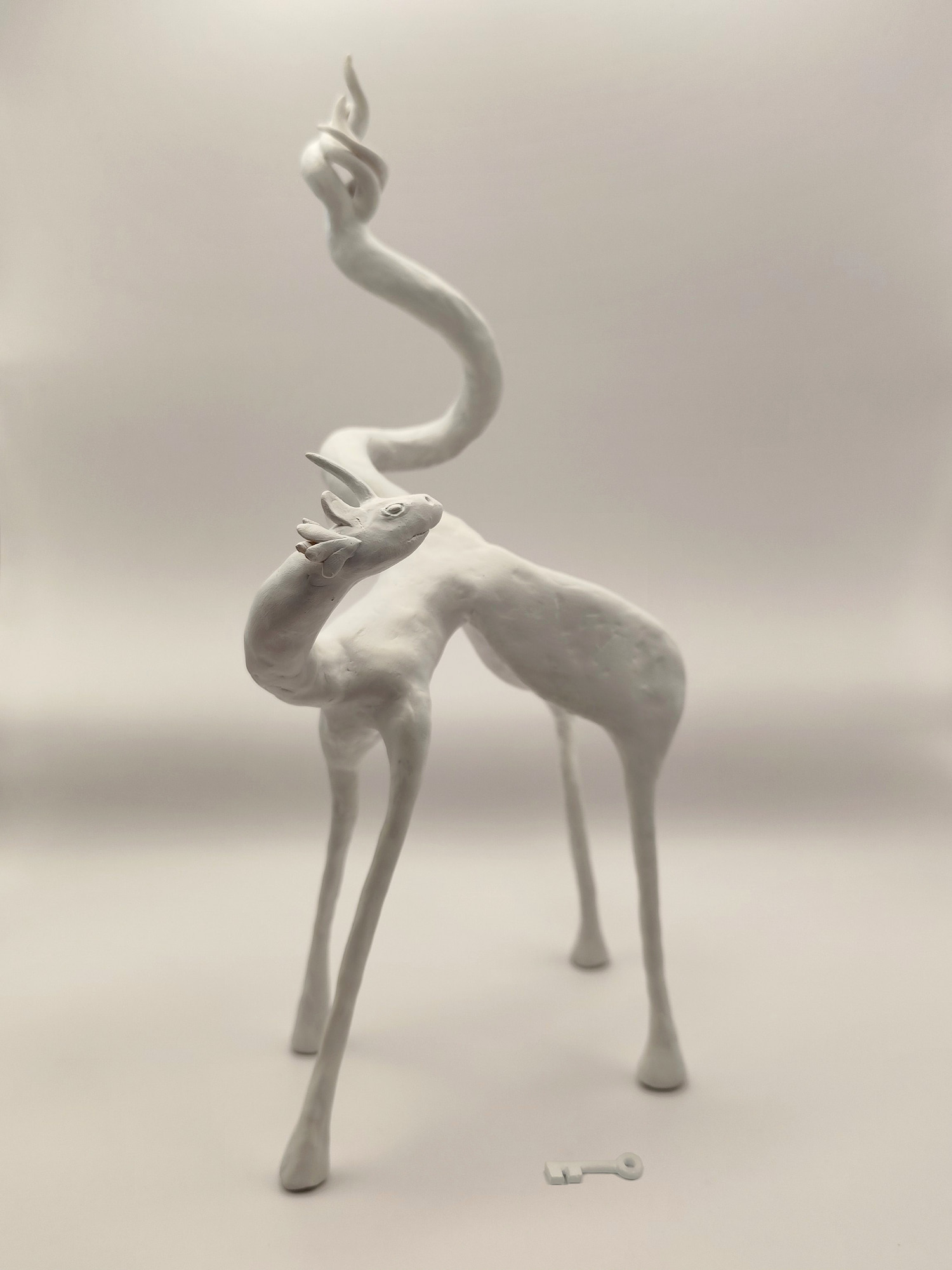
The Guardian: Key
Blanca de la Torre
Polymer medium, acrylic paint, and metal armature.
Two-piece installation. Piece 1: 28 x 13 x 12 cm; Piece 2: 0.2 x 2 x 0.6 cm.
2026
"The lock has transfigured into code.
The custodian does not obstruct passage; it preserves its meaning.
The key is not concealed, but offered to the gaze."
The Guardian: Key
Conceptual Rationale and Proposition
I. The Anthropology of Access and the Semiotics of the Threshold
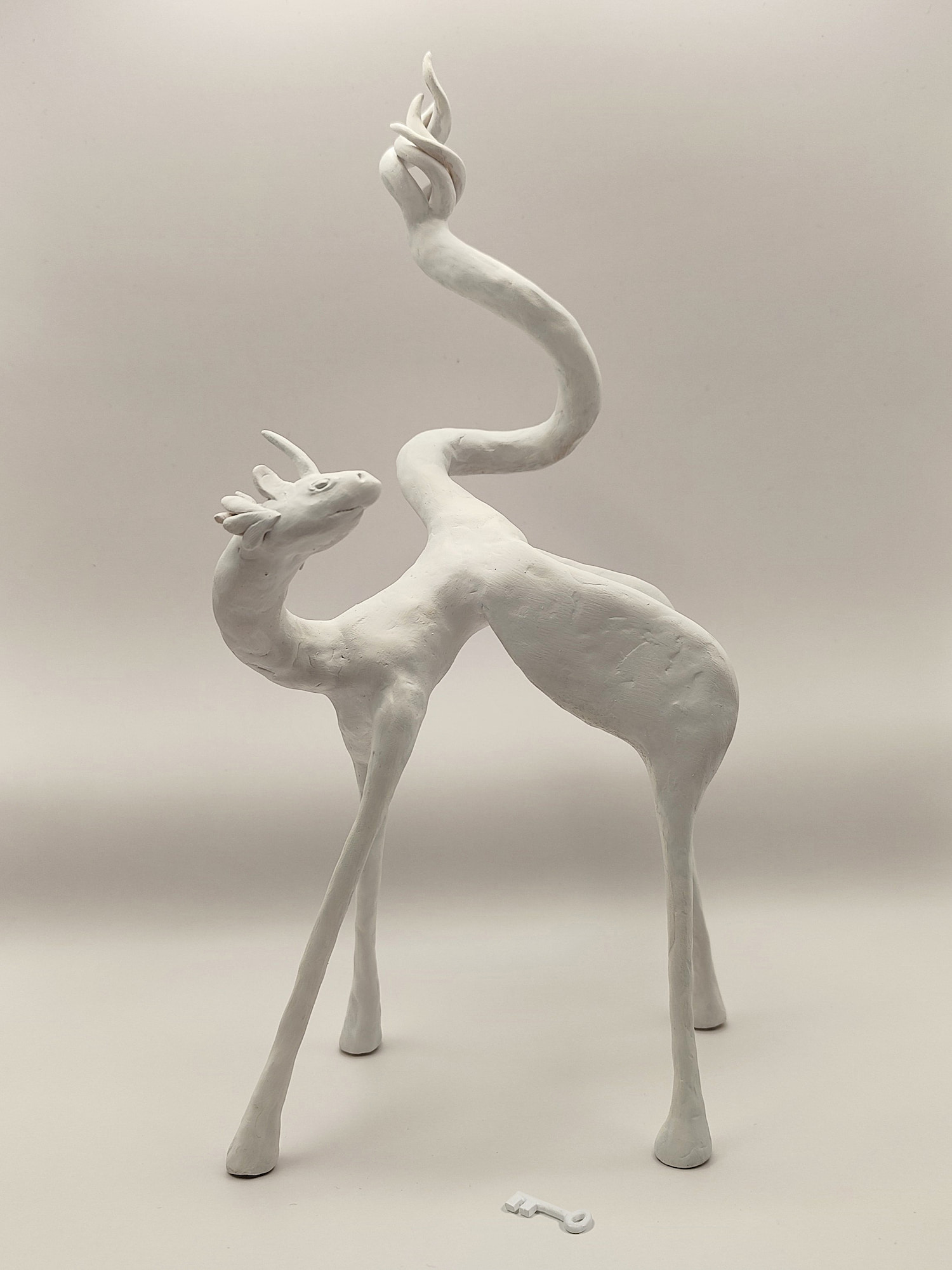
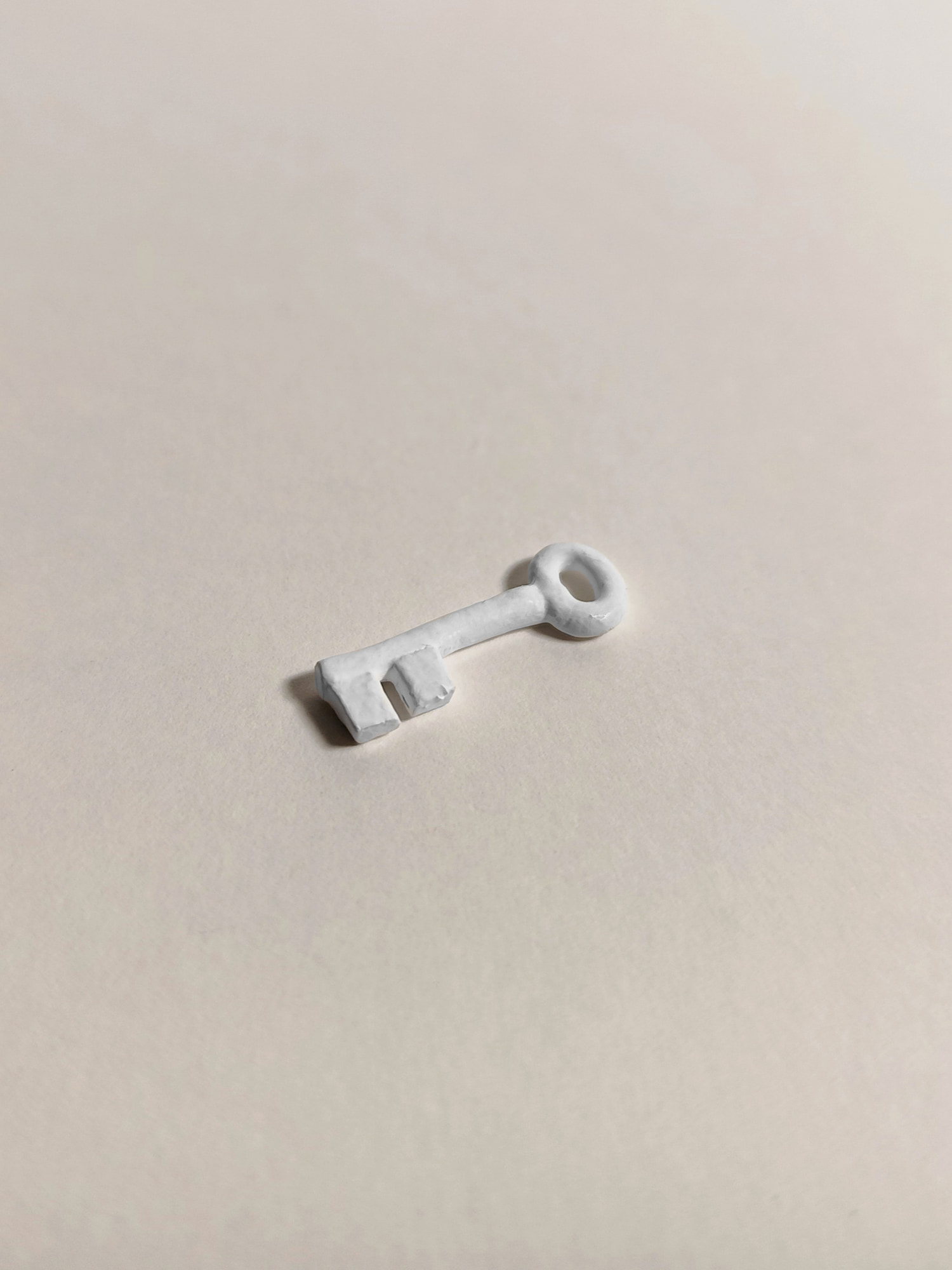
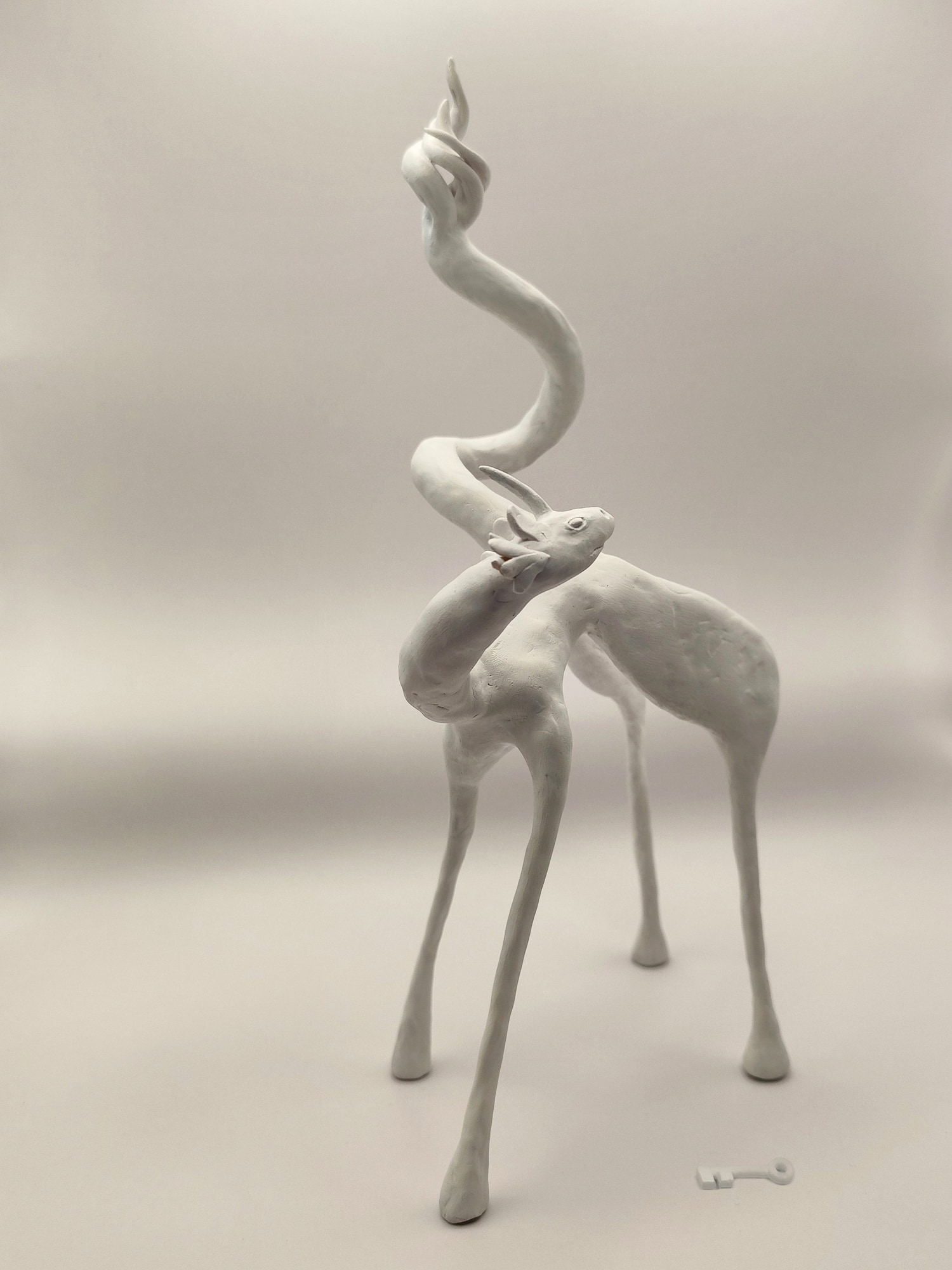
This sculptural proposal unfolds an analytical investigation into the persistence of the guardian archetype and the symbolic nature of opening. Through a bodily form of draconic lineage with extraordinarily elongated limbs, a frontal appendage recalling the figure of the unicorn, and a tail coiling upward toward which the head directs its gaze, the piece establishes a direct tension with a minute object positioned at its base: an autonomous key resting on the horizontal plane. The work avoids literal illustration, configuring instead a spatial device through which to reflect on how acts of closure, revelation, and passage maintain their structural resonance within contemporary culture.
II. The Dialectic of Access: From Myth to Narratives of the Code
In the anthropology of the symbol, an object designed to open or close a space is never a mere technical instrument, but an ontological operator. In archaic Mediterranean traditions, the goddess Hecate held the keys to liminal passages, signifying authority over transit between dimensions, much as the god Janus presided over city gates as the regulator of temporal and territorial transitions.
Around the concrete figure of the key gravitates a crucial contemporary shift: the progressive displacement of the physical tool by algorithms, alphanumeric keys, tokens, and biometric authentication within digital environments. Without seeking to illustrate specific fictions or technological developments, the physical presence of the key at the entity's feet operates as a material anchor from which to examine how the mechanics of transit have migrated into contemporary mass culture. The artwork's structure offers a primary model for understanding narrative phenomena in which the physical object is transfigured into code: a parallel example is found in the Doors of Durin within the universe of The Lord of the Rings, a monolithic threshold where the traditional key is replaced by the deciphering of a linguistic riddle.
Similarly, within the conceptual architecture of the Gate of Truth in Fullmetal Alchemist, a serene, monochrome entity guards the portal of supreme knowledge, demanding a confrontation with the subject's own psychic structure before granting access. Likewise, throughout the passages of the film Labyrinth, the guardians pose conceptual paradoxes whose resolution relies on logical reasoning. In all these instances, the figure of the custodian and the test of entry abandon physical confrontation to articulate dilemmas of an epistemological order. The work transforms this object into an autonomous, tactile sign that functions as a catalyst, questioning how we position ourselves before the boundaries of knowledge and what it means, in a profound sense, to possess the capacity to cross a threshold.
III. The Entity at the Threshold: Anatomical Torsion and Introversion of the Libido
The figure's bodily structure reinterprets the ancestral iconography of the dragon, mythology's quintessential guardian archetype. Traditionally, the dragon has embodied territorial force, hoarding, and a telluric threat that bars passage through intimidation or terror. In this piece, however, that instinctual charge sheds its dense, aggressive mass, mutating into a geometry of lightness, silence, and suspended elegance.
Its anatomy incorporates a unique cranial horn at the front, hybridizing dragon morphology with the unicorn tradition. Throughout the history of ideas, the figure of the unicorn underwent a complex evolution: described in classical antiquity by chroniclers such as Pliny or Ctesias as a fierce, indomitable beast, medieval narrative ultimately moralized it, transforming it into a symbol of gentleness. By reintroducing the single horn atop the dragon’s head, the sculpture does not seek to domesticate the beast, but to channel its energy. Here, the horn functions as the arrow of the intellect and the axis of mental sharpness, a vector of discernment capable of focusing thought and filtering environmental noise.
Complementing this anatomical synthesis is the complete turn of the neck, which shifts the creature’s gaze toward the tip of its own tail, a form that culminates in an organic spiral evoking a gust of wind or a breath in motion. Within the framework of Carl Jung's analytical psychology, this cranial contortion embodies the introversion of the libido, understood as general psychic energy. By withdrawing the focus of attention from the defenses and projections of the external world, the guardian folds its vital force back onto the observation of its own source. The creature does not watch the viewer with hostility; its posture suggests a consciousness centered on its internal dynamics, transforming guardianship into an act of psychic self-regulation and introspection.
IV. The Disarticulation of Agency: The Autonomous Artifact and Comparative Anthropology
The core of this analysis lies in breaking the traditional hierarchy between the custodian and the instrument of access. Historically, the guardian carried the key attached to its body or hidden within its keep, reinforcing a monopoly over the threshold. Here, the key lies on the floor, physically detached from the animal’s limbs, yet cast from the very same polymeric substance. This spatial separation introduces an epistemological turn: the key is neither captive nor concealed, but laid out in absolute horizontal exposure before the viewer.
This detachment disrupts conventional notions of guardianship and reconfigures the relationship with liminal figures of mythical tradition. The piece does not act like Cerberus, devouring by instinct; rather, it shares an affinity with the Theban Sphinx or Eastern portal guardians such as the Dvarapala and Men Shen. These architectural entities do not seek the destruction of the traveler, but rather mark the boundary where external chaos ends and internal concentration begins, demanding cognitive maturity before permitting passage. By placing the key at the creature’s feet, agency shifts irrevocably toward the viewer. The higher entity does not withhold the tool; it holds it within the shared space, positioning it as a catalyst charged with latent power that calls upon the observer to act as the true executor of the experience and of its decipherment.
V. Formal Synthesis and the Experience of Space
On a formal level, the sculpture resolves into a concise composition of linear architecture and graphic restraint. Its monochrome surface eschews added pigments to concentrate tension within the sweeping curves and the weightlessness of its elongated limbs. This economy of means allows ambient light to cast soft shadows across the torso and the tail's spiral, heightening the tactile quality of the hand-modeled surface.
By placing the figure alongside the key within the neutrality of the white cube, the work consolidates itself as a degree zero of the archetype: a three-dimensional reminder that the need to decipher a code, respect for the threshold, and the demand for mental clarity remain fundamental axes through which the human mind maps the unknown. In this manner, the piece operates as a critical hinge in which the key abandons its status as a simple physical opening mechanism to become a catalyst for discernment. It stands as an analytical operator designed to decode the structures governing our perception of change, articulating processes of transit and the shift from one paradigm of knowledge to another.