
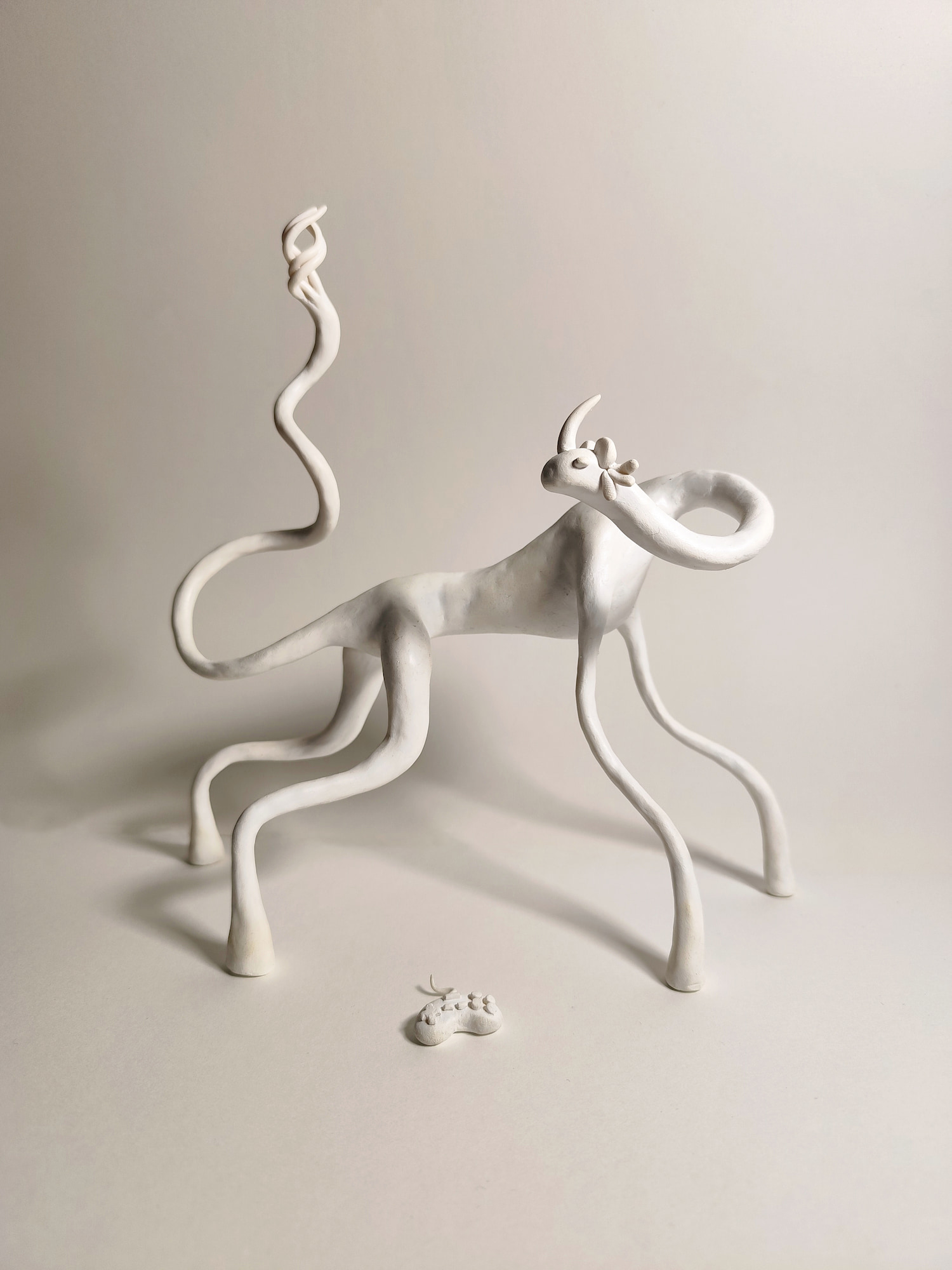
The Guardian: Mythology
Blanca de la Torre
Polymer medium, acrylic paint, and aluminum armature.
Two-piece installation. Piece 1: 22.6 x 22 x 10 cm; Piece 2: 0.9 x 2.5 x 2.7 cm.
2026

"The dragon no longer buries gold in the shadow of the cavern, but guards the interface of adventure.
It no longer fights with the ferocity of the flesh, but demands an elevation of discernment before the threshold.
It no longer belongs to the density of the earth, but to the subtle weightlessness through which the narrative transmigrates."
The Guardian: Mythology
Conceptual Rationale and Proposition
I. The Transmigration of Myth in the Digital Age
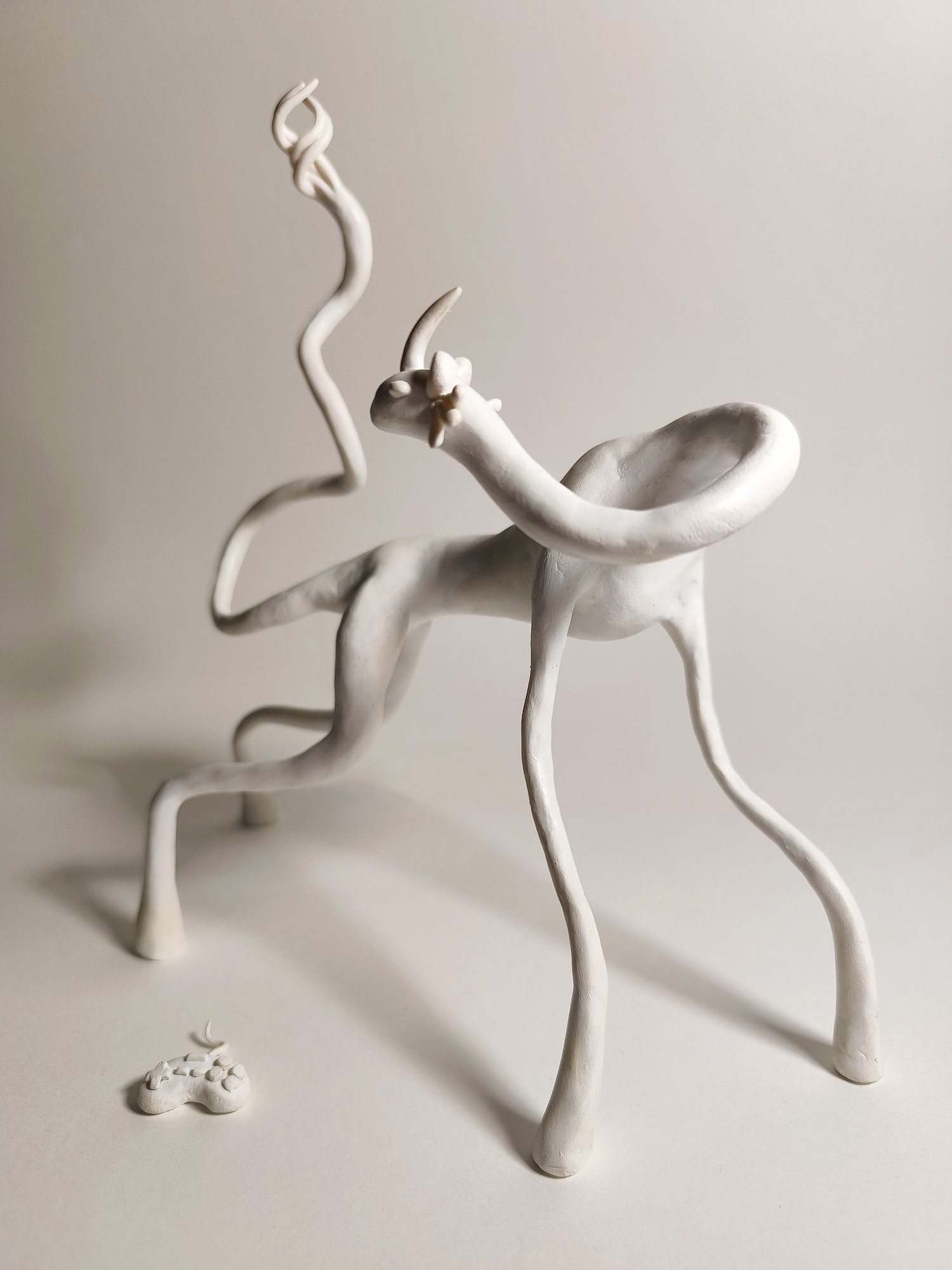
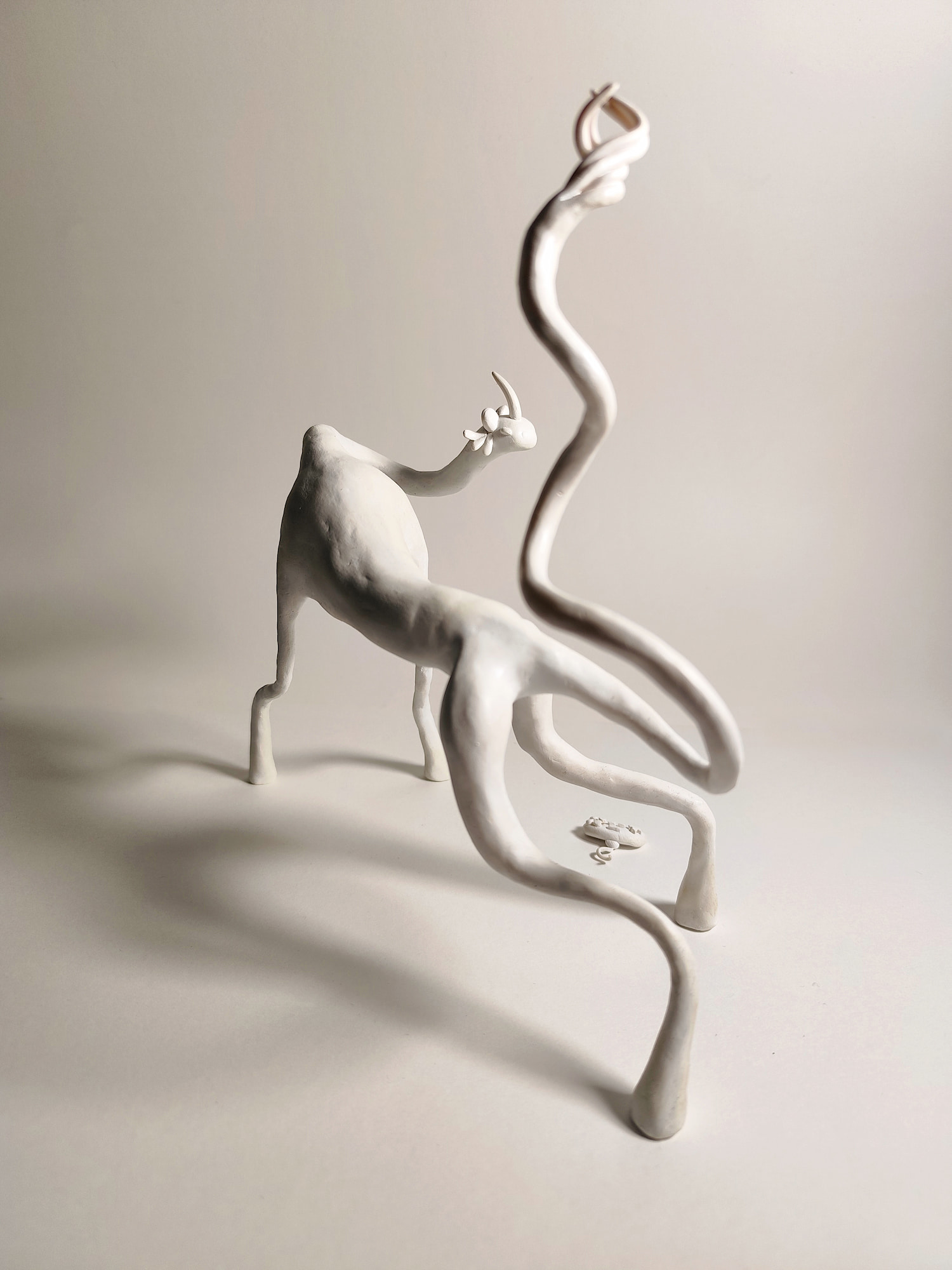
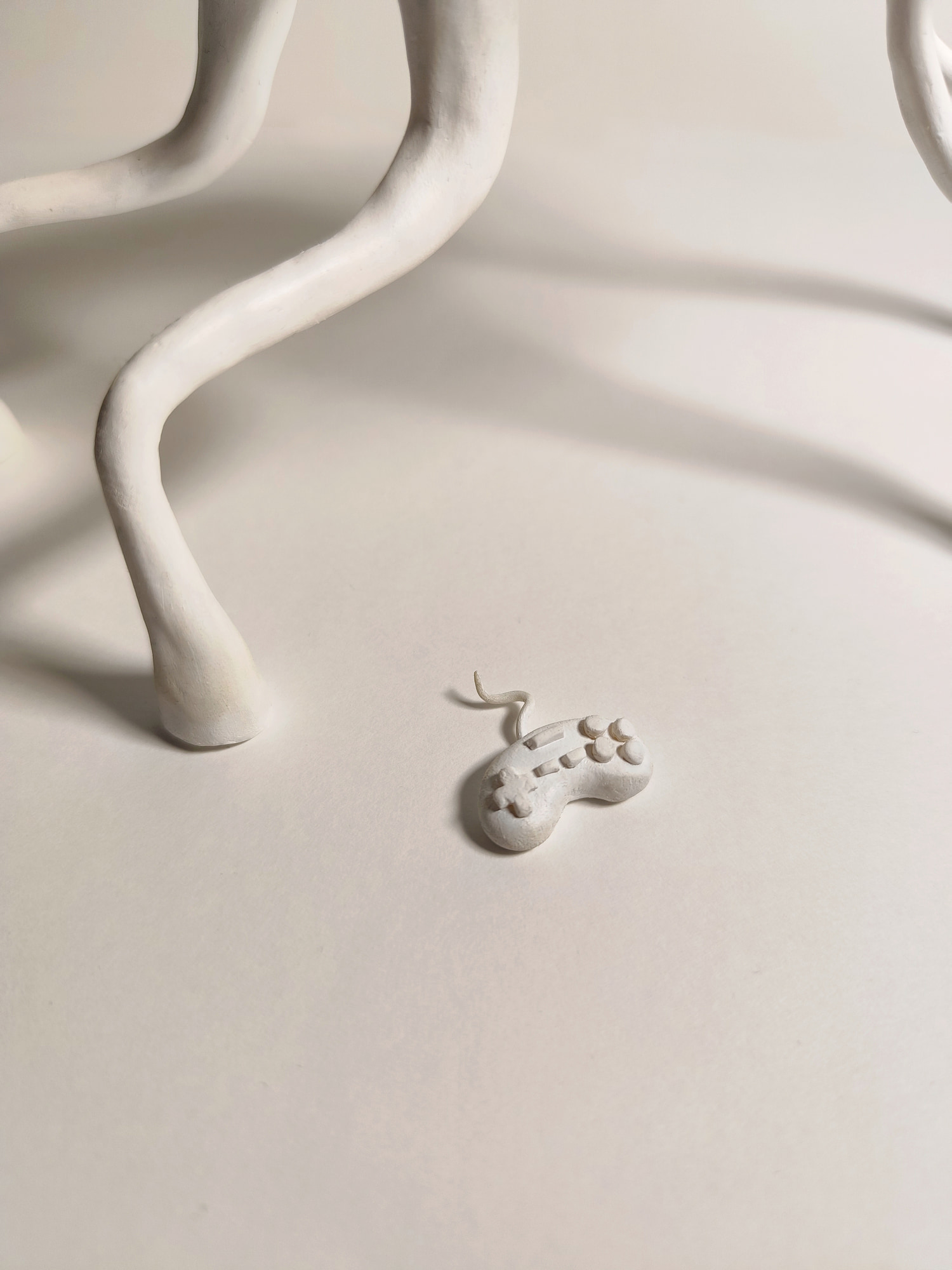
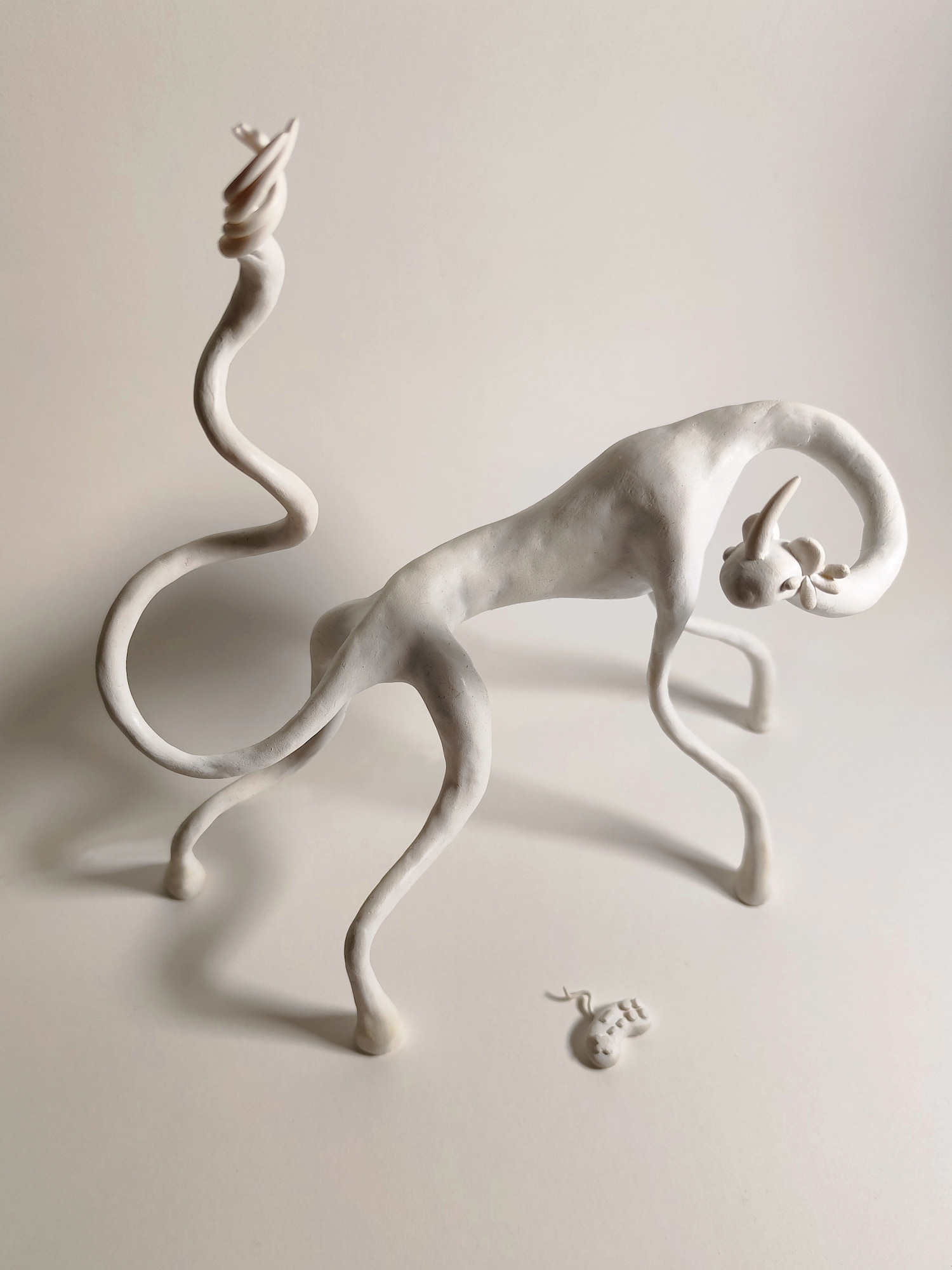
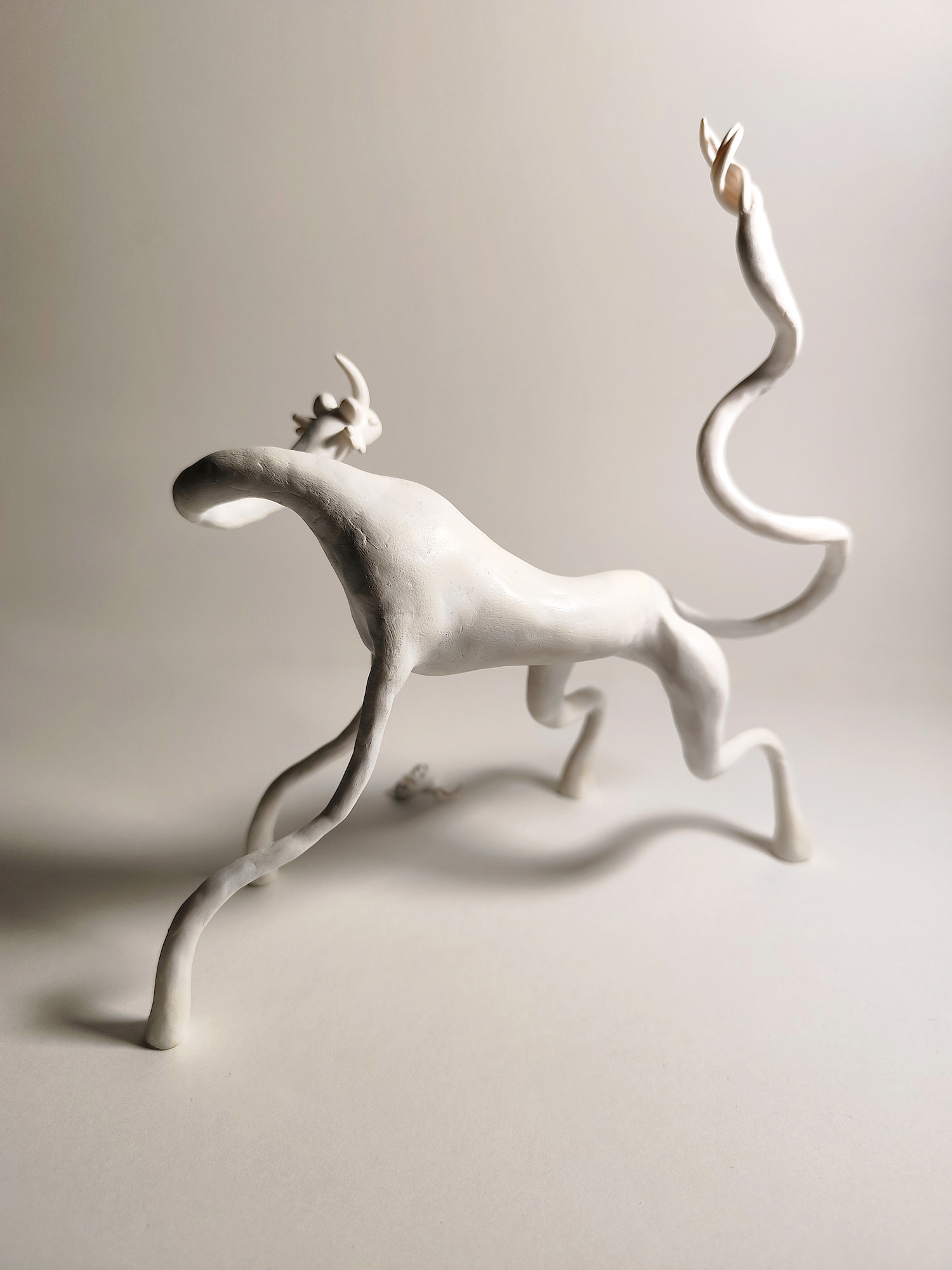
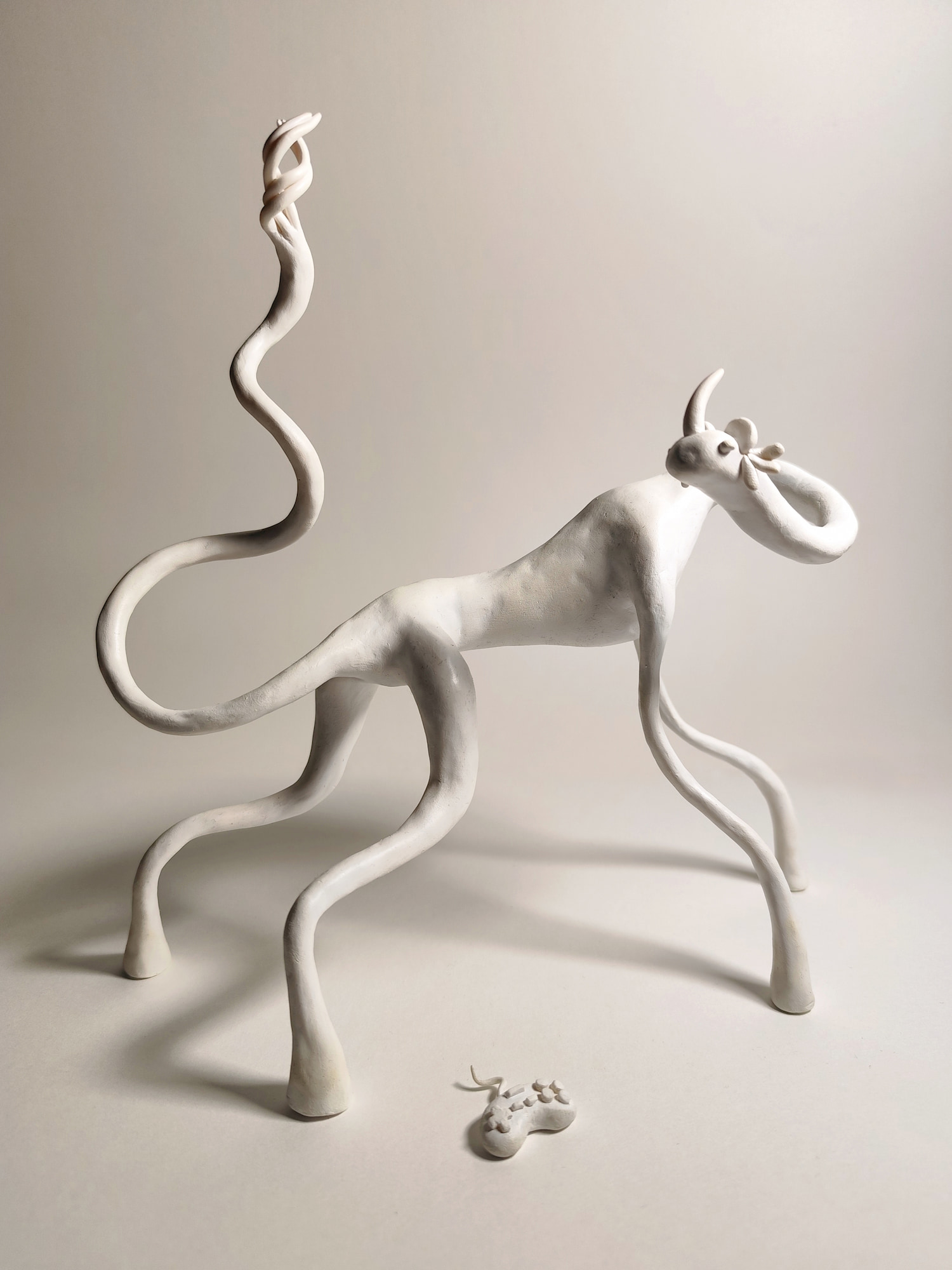
On a strictly formal level, this sculpture articulates a stylized organic silhouette that synthesizes mass into an architecture of fluid, ascending lines, elevating the creature's body in a continuous spiral that culminates in a frontal horn and a sweeping tail, while positioning at its base, directly on the floor surface, the monochrome representation of a classic video game controller devoid of commercial branding.
II. Anthropology of the Threshold and Cthonic-Ascendant Dialectic
Within the theoretical framework of analytical psychology formulated by Carl Gustav Jung, the figure of the dragon operates as one of the most recurrent archetypal constructs in cultural anthropology: the guardian of the threshold (Schwellenhüter). This structure functions as a model of symbolic containment that delineates the boundaries between the realm of ordinary consciousness and the unintegrated regions of the unconscious. In this conceptual framework, access to latent contents or inner treasures is theorized as a deliberate confrontation with this figure during the process of individuation.
The historiographical interpretation of this guardian is articulated according to the symbolic regime of each civilization. In the European cultural matrix of Judeo-Christian roots, the dragon traditionally embodies an earthly, hoarding force that immobilizes the flow of life. This iconographic convention is materialized in classical antiquity and the Norse sagas: in Greek mythology, the dragon Ladon guards the golden apples in the Garden of the Hesperides as a symbol of unattainable immortality; in the Völsunga Saga, the transformation of the dwarf Fáfnir into a monstrous serpent serves as a moral allegory on how material greed condemns the subject to paralysis within the gloom of a rocky cavity. In these narrative frameworks, the creature personifies the inertia of matter, requiring the hero as an agent of rational resolution.
Conversely, comparative mythology indicates that in Eastern and Mesoamerican cosmovisions, the serpentine figure is conceptualized through an integrative logic. The Long of the Chinese tradition and the Japanese Ryu are not depicted as cavernous monsters, but as agents of fertility, regulators of the waters, and mediators between the cosmic order and social organization. Similarly, the Mesoamerican deity Quetzalcoatl functions as an iconographic code synthesizing terrestrial matter and celestial transcendence, articulating a visual bridge between the divine and the earthly.
The elongated anatomy of this sculpture adopts a vertical ascent vector that reinterprets the inertia of the medieval creature through a line of weightlessness. This configuration visually references the grammar of the alchemical tradition, borrowing the codes of transition between Nigredo and Albedo. While in Renaissance treatises Nigredo codes the initial phase of dissolution and cthonic density of raw matter, Albedo represents the stage of purification and formal clarification. The monochrome palette inscribes mass into this aesthetic of refinement, converting the monster's heaviness into a channel of conceptual elevation.
III. Hermetic Hybridization: The Monoceros and Alchemical Rectification
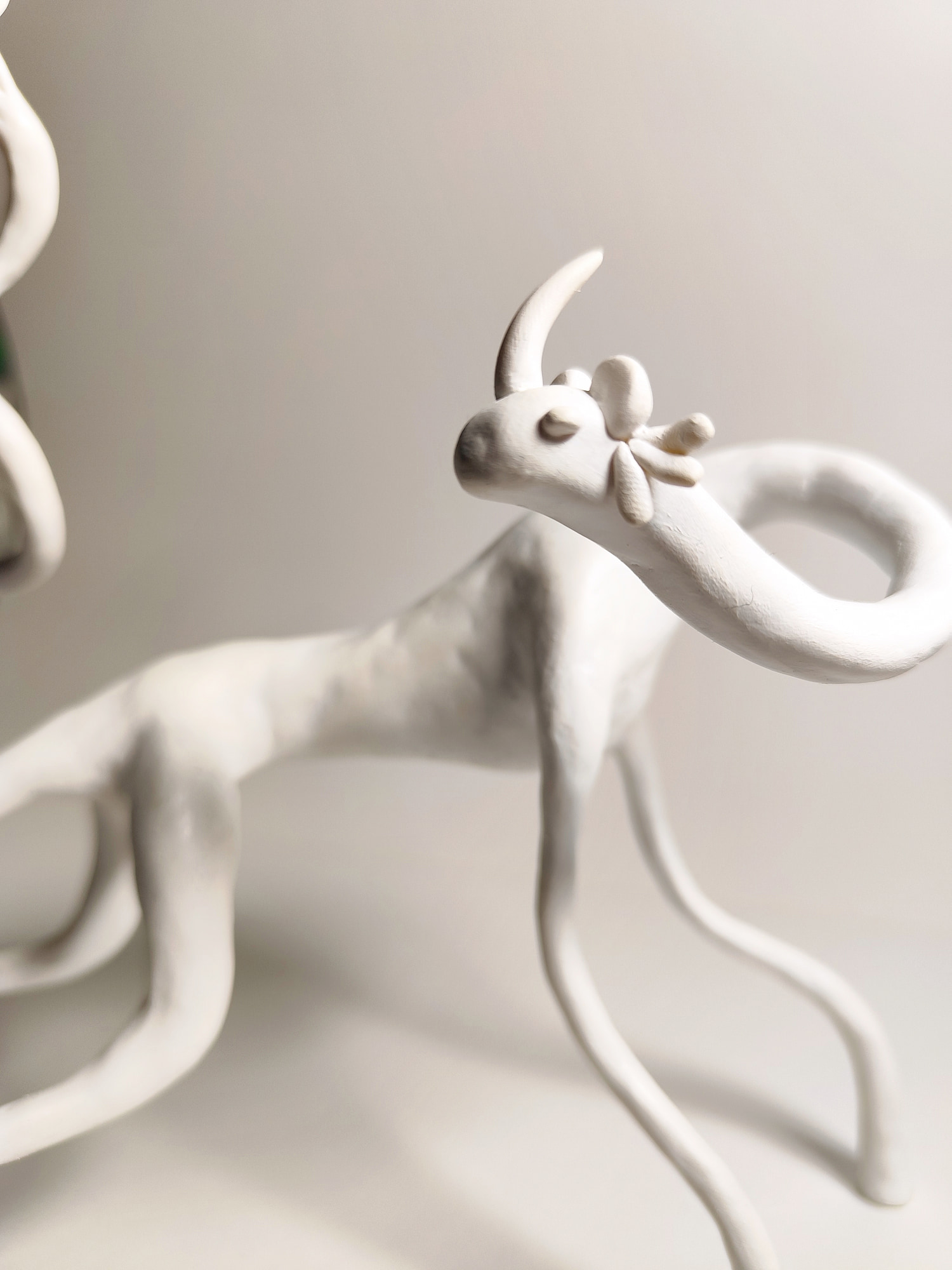
An isolated, curved horn is inserted into the head of the creature, modifying the reading of the symbol. Comparative mythology and the treatises of the Hermetic tradition historically analyze the figure of the Monoceros (the unicorn) as the iconographic counterpoint to the terrestrial serpent. In the engravings of the Renaissance alchemical laboratory, the dragon functions as a representation of the Prima Materia associated with Sulfur, the igneous, fixed, and instinctual principle rooted in the body. The unicorn, for its part, operationalizes Mercury in its theoretical dimension: the volatile and incorruptible principle associated with the Logos and intellectual knowledge.
By sprouting the horn structure directly from the creature's cranium, the work formally cites the concept of the Coniunctio Oppositorum or union of opposites of the Magnum Opus. The telluric impulse attributed to the reptile is channeled by the verticality of the unicorn's attribute, offering a visual metaphor for cognitive structuring over instinctual force.
This cross-referencing finds its most precise equivalent in the figure of the Qilin (or Kirin), the chimera of Chinese and Japanese traditions combining cervine or serpentine traits with a single frontal horn. Ancient mythological sources document the Qilin as a peaceful entity that floats above the grass to avoid altering its environment, manifesting as a sign of social harmony or erudition. In the piece, the aggressiveness assigned to the primordial monster is subordinated to a higher order.
In symbolic anthropology, the placement of this apex in the frontal region of the head historically marks the center of cognitive development and intuitive perception. The horn thus operates as a formal device of concentration that reconfigures the figure of the guardian: it is not presented as a destructive obstacle requiring the violence of the sword, but as a structure of perceptive focus demanding intellectual maturation before crossing the threshold toward latent knowledge.
IV. The Interactive Interface and the Reconfiguration of the Mythic Treasure
At the base of the sculpture, resting on the physical floor, the presence of the video game controller introduces a decisive articulation with contemporary visual culture. The piece reconfigures the economy of myth by executing a critical displacement regarding the concept of the guarded treasure. In classical narratives, the creature watches over an inert booty consisting of accumulations of gold, gems, or relics. In this proposal, the object of custody shifts toward an interactive interface devoid of industrial branding, turning the simulation of adventure itself into the primary object of contemporary value.
The ludic device is presented as the key to accessing the virtual geographies where contemporary subjects perform their rites of passage. The structures of the monomyth formalized by Joseph Campbell (the call to adventure, crossing the threshold, the initiatory trial, and the return) have migrated from epic texts to interactive environments. In contemporary dark fantasy narratives and avant-garde video game design, the role of final bosses analytically reproduces the function of the archetypal threshold guardian. These entities do not operate as mere mechanical hurdles, but as custodians of technical competence, motor mastery, or strategic understanding that the player must assimilate. Error, repetition, and defeat are not articulated as ultimate failures, but as stages of a structured learning process that forces the evolution of mental schemas.
By placing the controller at the feet of the guardian, the work formalizes an alliance between the creature and the interface. The dragon no longer hoardingly retains access like the Fáfnir of the sagas; it assumes the tutelary function present in Eastern traditions, guarding the instrument that allows the individual to activate their own transformation through the experience of simulation.
V. Transmigration of the Narrative: Interfaces and Mythologies of the Image
The dialogue established by the work points to the phenomenon of the migration of discursive structures in the information age. Through the processes of desacralization and industrialization in modern society, foundational narratives and traditional mythologies experienced a progressive loss of hegemony. However, the narrative schemas of the human psyche transmigrated toward new technological and audiovisual media.
This dynamic of conceptual assimilation finds its most elaborate formulation in late twentieth-century avant-garde animation and philosophical cyberpunk literature, where biomechanical interfaces and computing systems integrate with theological iconography and existential dilemmas surrounding identity. Technology ceases to be depicted as a mere functional tool and becomes a ritualized space where the individual confronts the anguish of isolation, the process of individuation, and the quest for integration with the whole.
Likewise, in seminal narratives of philosophical science fiction, conceptual meditations address the dissolution of bodily boundaries within a data-saturated environment, where the dissociation between the cybernetic shell and consciousness delves into the mind's capacity to navigate virtual networks. This approach extends to the evolution of artificial intelligences, where synthetic entities debate the nature of subjectivity, finitude, and self-consciousness. These pop-culture landmarks are not mere commercial entertainment products, but manifestations of a visual regime that utilizes cybernetization to reformulate fundamental ontological questions. The sculpture captures this theoretical current by demonstrating that humanity's searching schemas have not been neutralized by the digital age, but have instead allied with technology to structure new interactive myths.
VI. Technognosis and the Semiotic Relic in the Digital Era
The formal treatment of the console controller aligns it with the sociological theories formulated by Erik Davis in his study on Technognosis. Davis analyzes how information technologies and virtual environments do not eradicate symbolic thought or the search for transcendence, but act as new receptacles for historical gnostic currents. The gnostic impulse, understood historiographically as consciousness's desire to untether itself from the constraints of dense matter to access a realm of pure abstraction, finds its contemporary equivalent in immersion within digital environments.
Stripped of commercial logos, cables, and industrial iconography through the monochrome white finish, the console controller loses its status as a mass-consumer commodity and is elevated to the category of a semiotic relic and object of cultural mediation. The chromatic unification of the piece establishes a plane of ontological continuity between the mythic creature and the technological interface: both elements belong to the same conceptual order.
Interactive control devices, alongside video games, literature, and contemporary audiovisual narratives, operate in current culture as the primary realm where society's internal symbols and psychological processes are embodied, fulfilling the role historically served by myths, folktales, and legends. Just as ritual tools and Hermetic objects functioned in antiquity as instruments of mediation, these media act as conceptual passkeys designed to open gateways toward synthetic simulation spaces. The sculpture thus acts as an analytical record of the permanence of human mental schemas. Though communication channels mutate from oral traditions and stone to silicon and screens, the structural necessity to confront the guardian, overcome psychic resistance, and participate in the rite of adventure remains unaltered at the core of contemporary culture.