
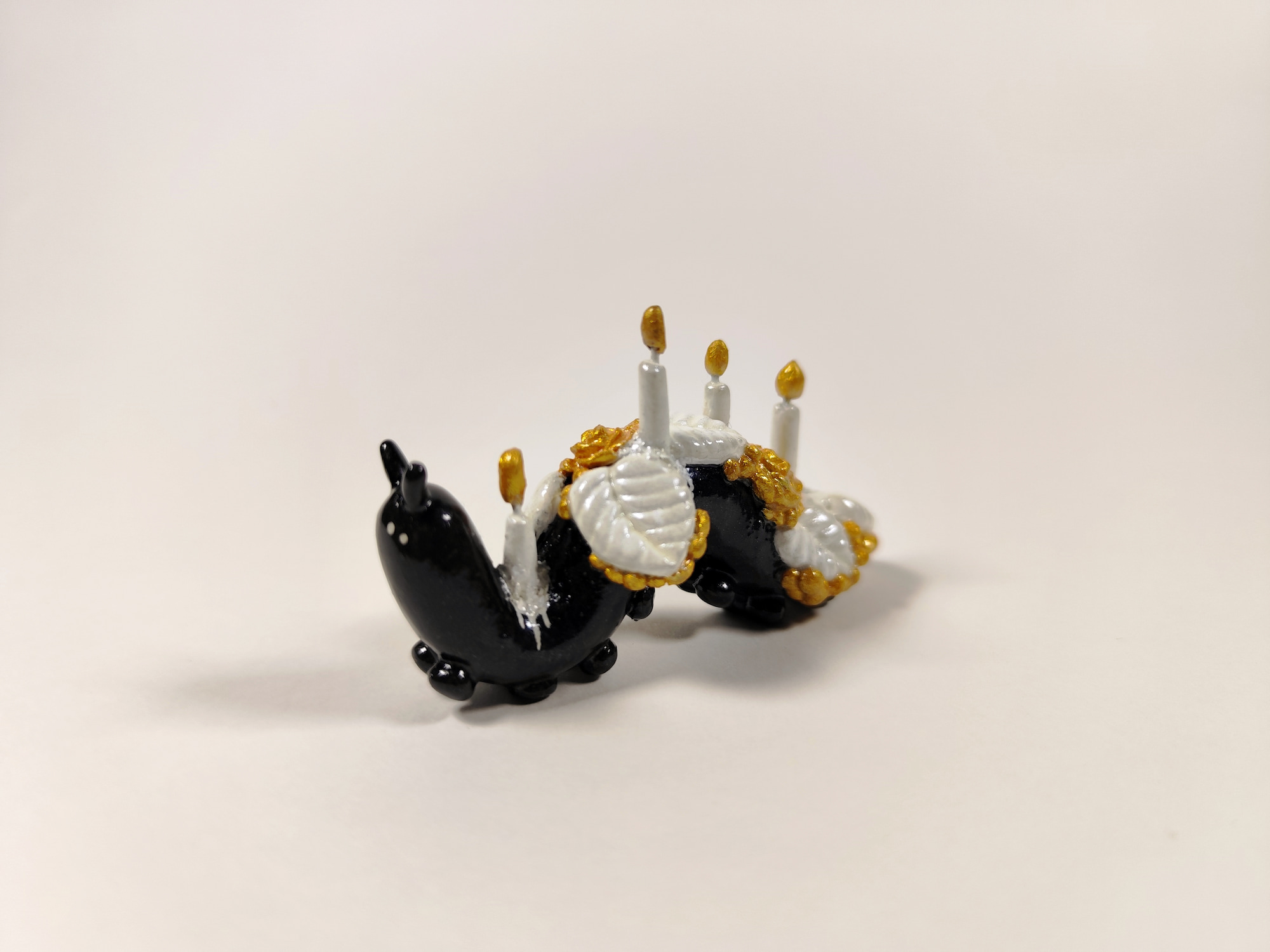
The Living Sanctuary of Maternity
Blanca de la Torre
Polymer medium and acrylic paint.
4 x 7.5 x 2.5 cm.
2026
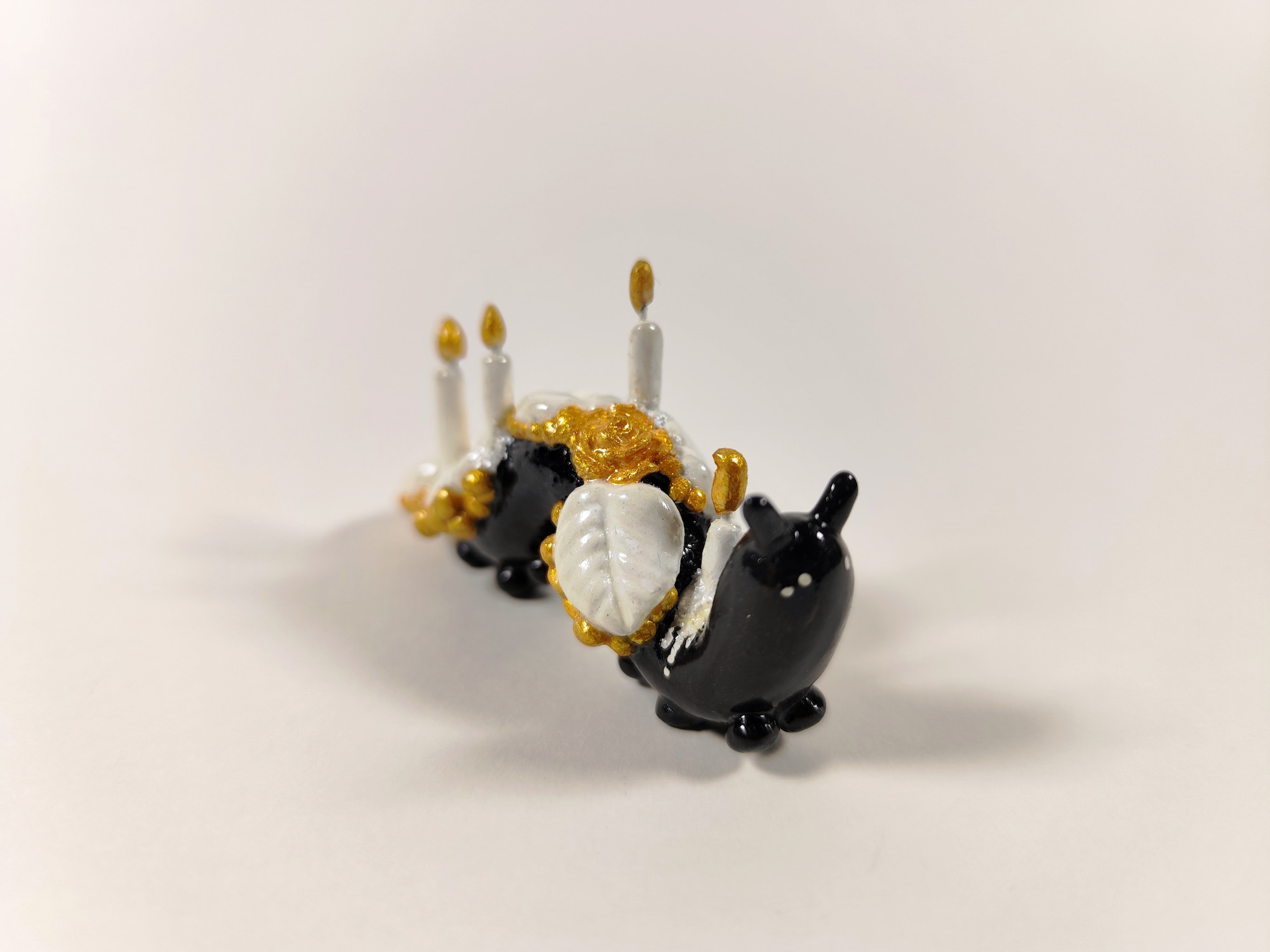
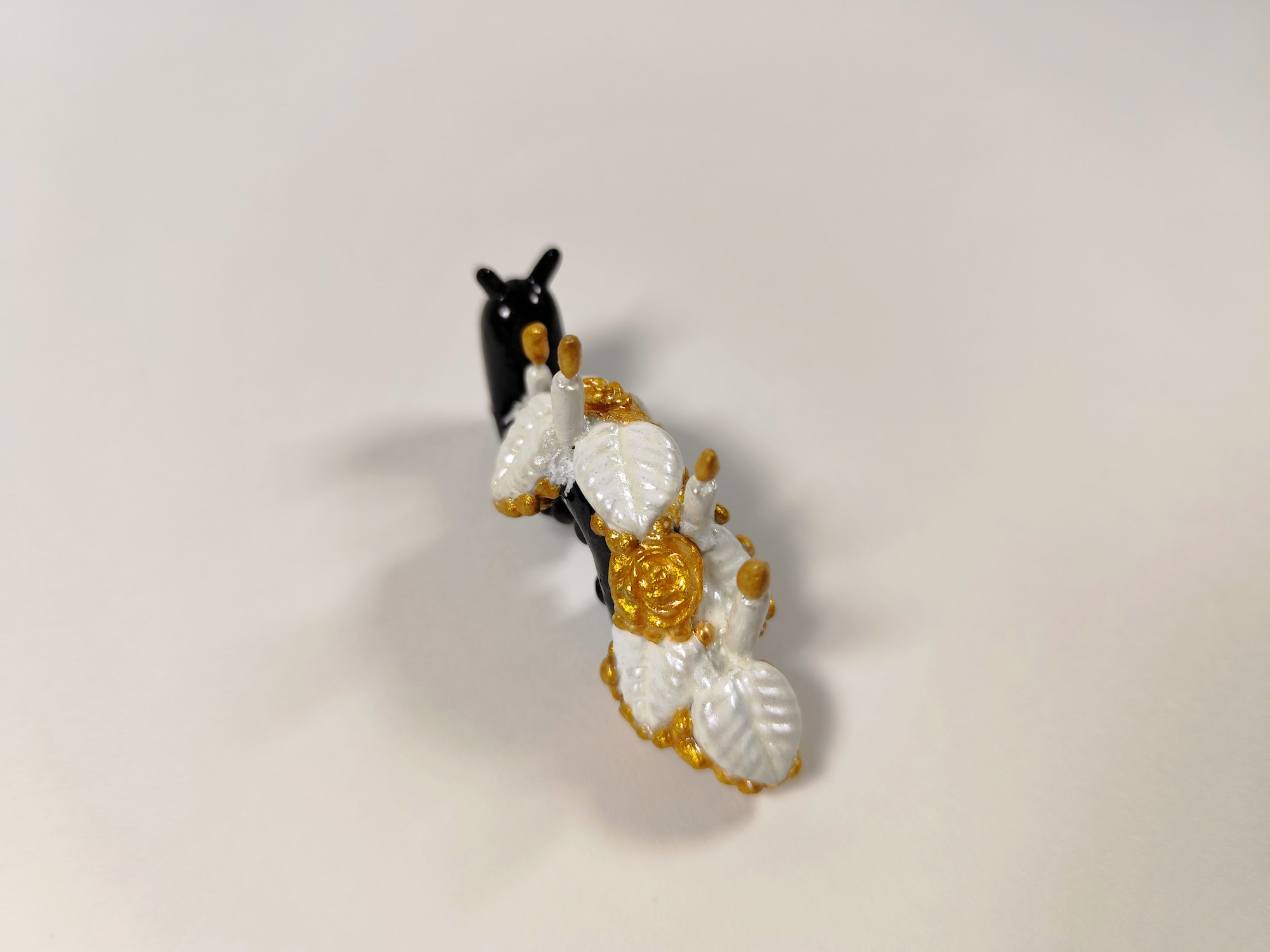
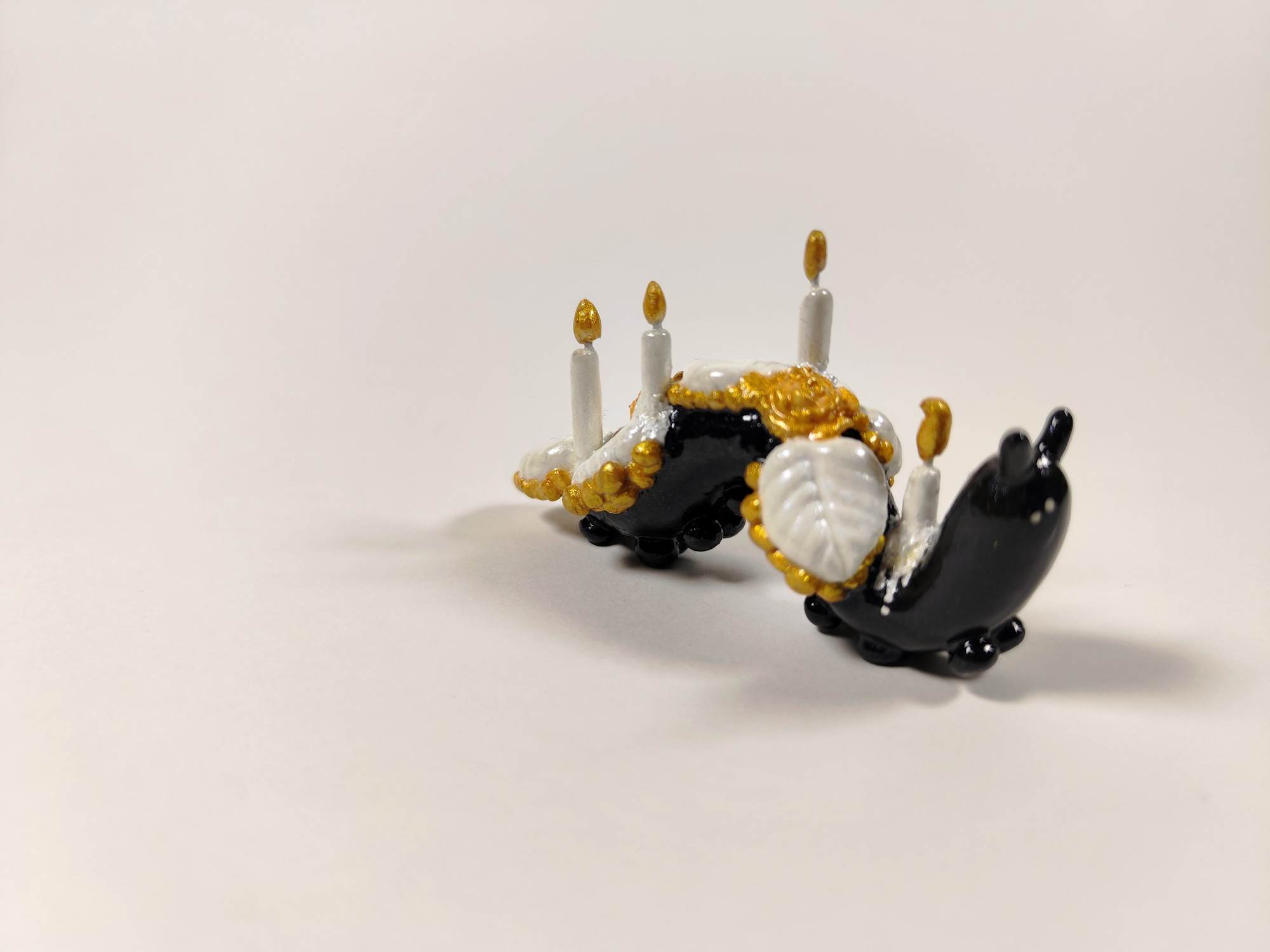
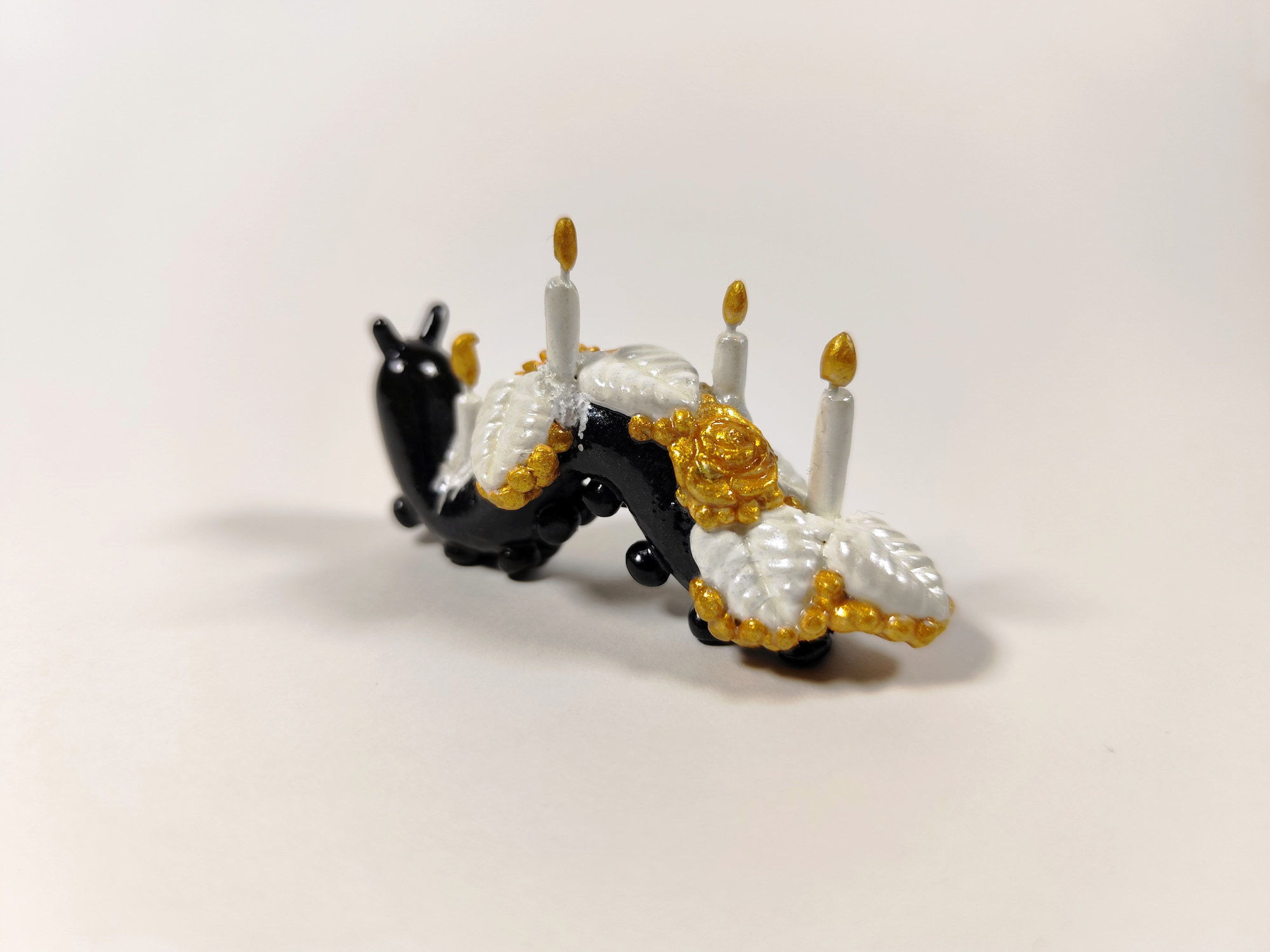
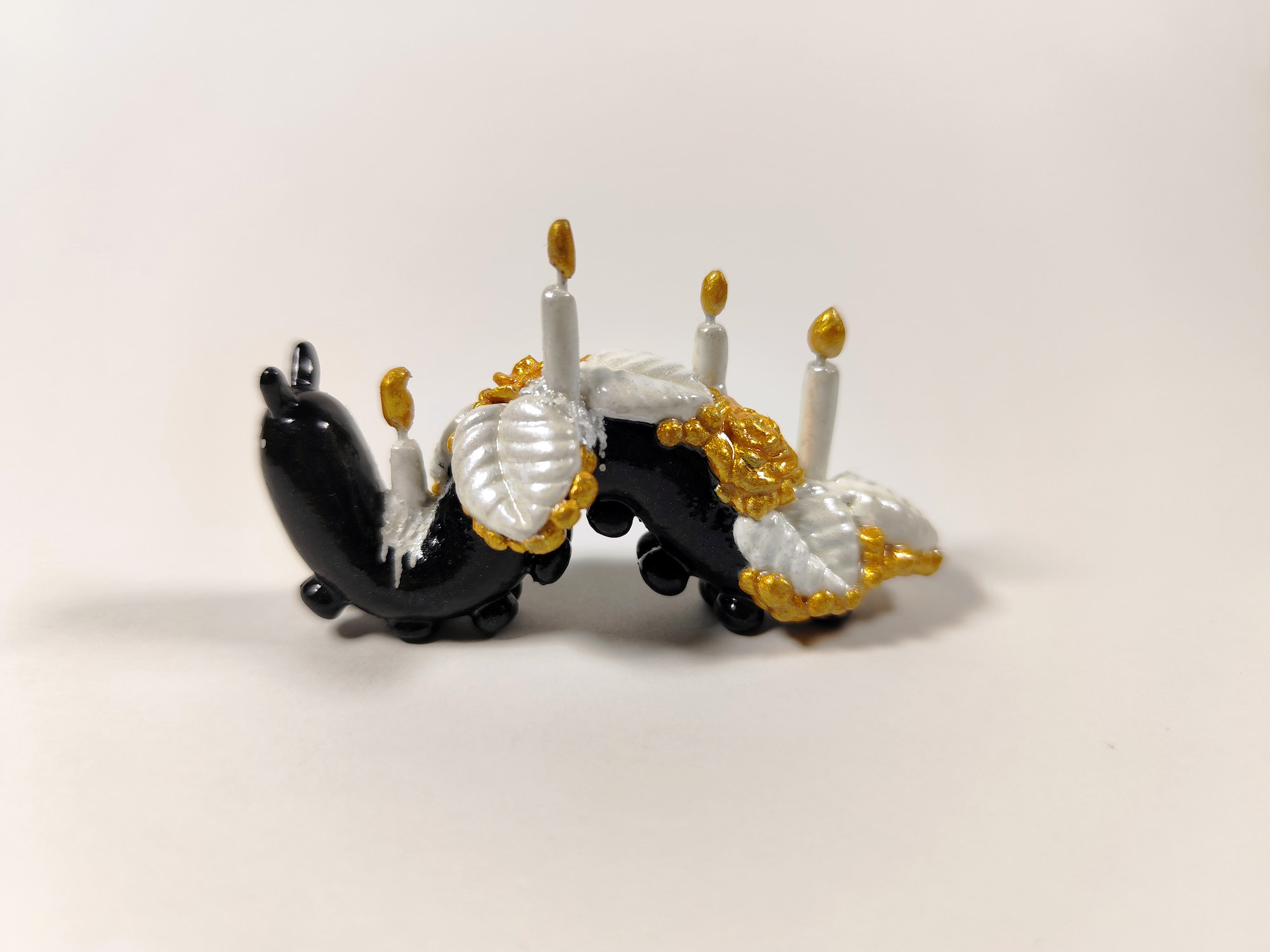
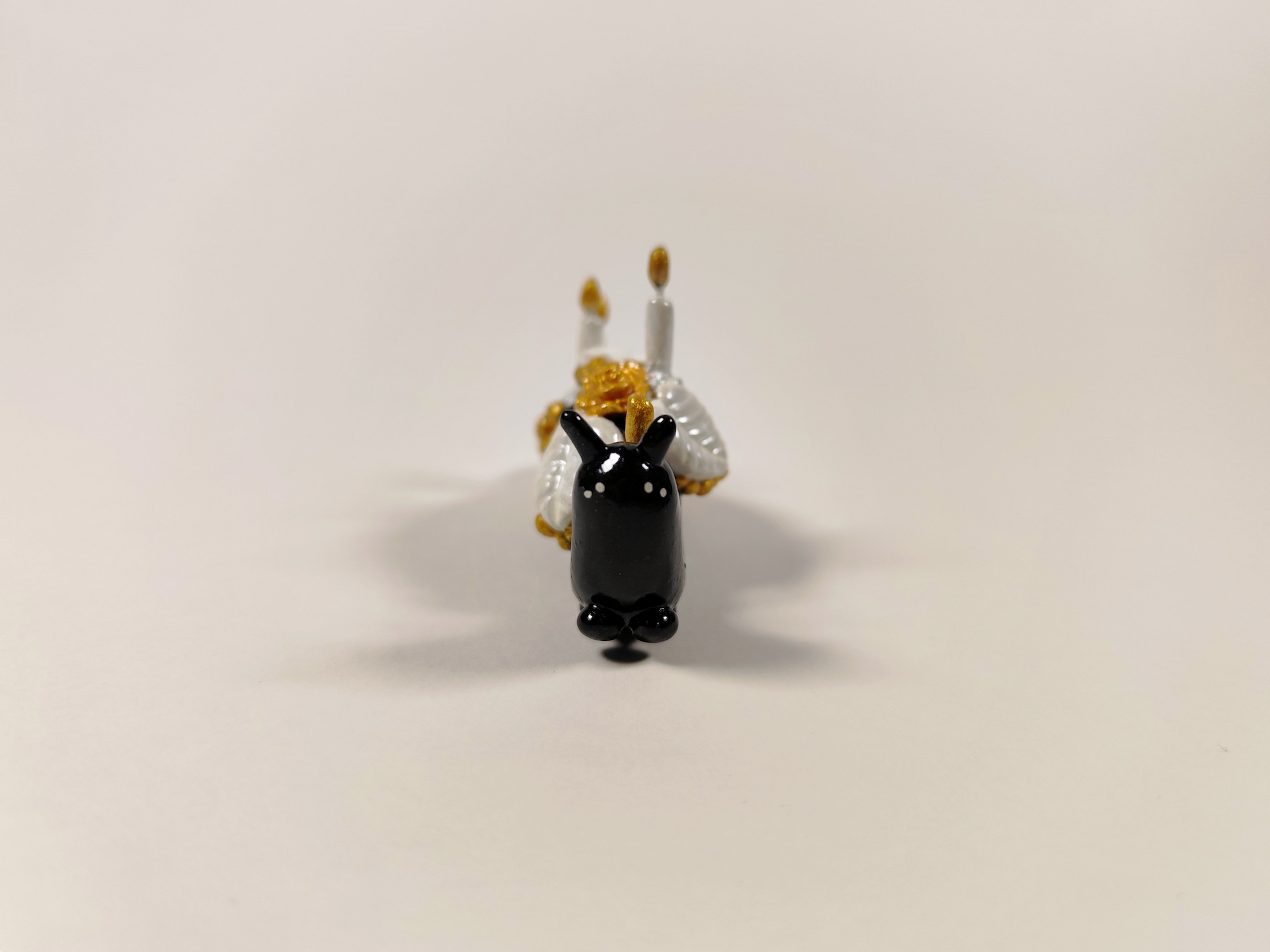
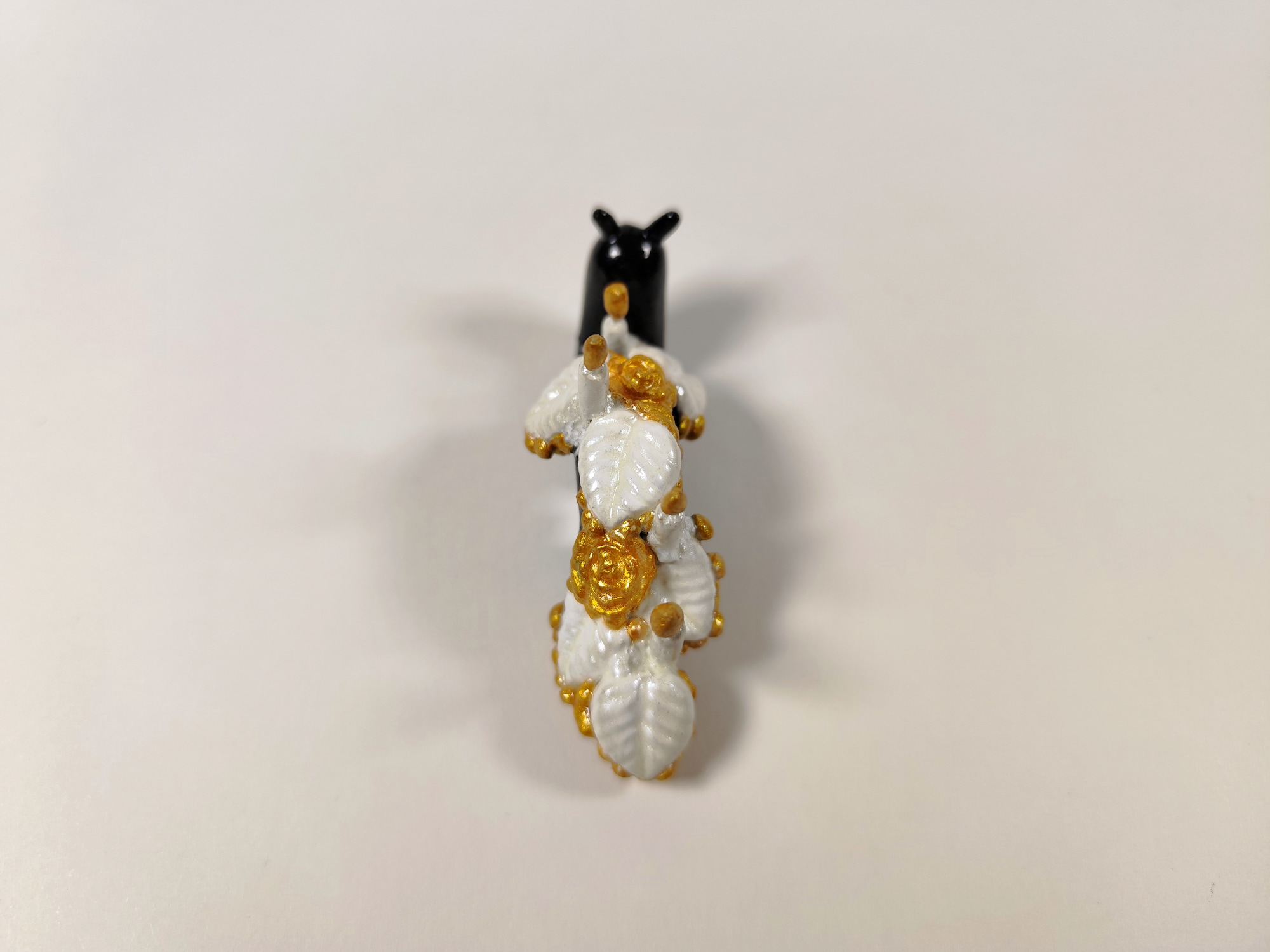
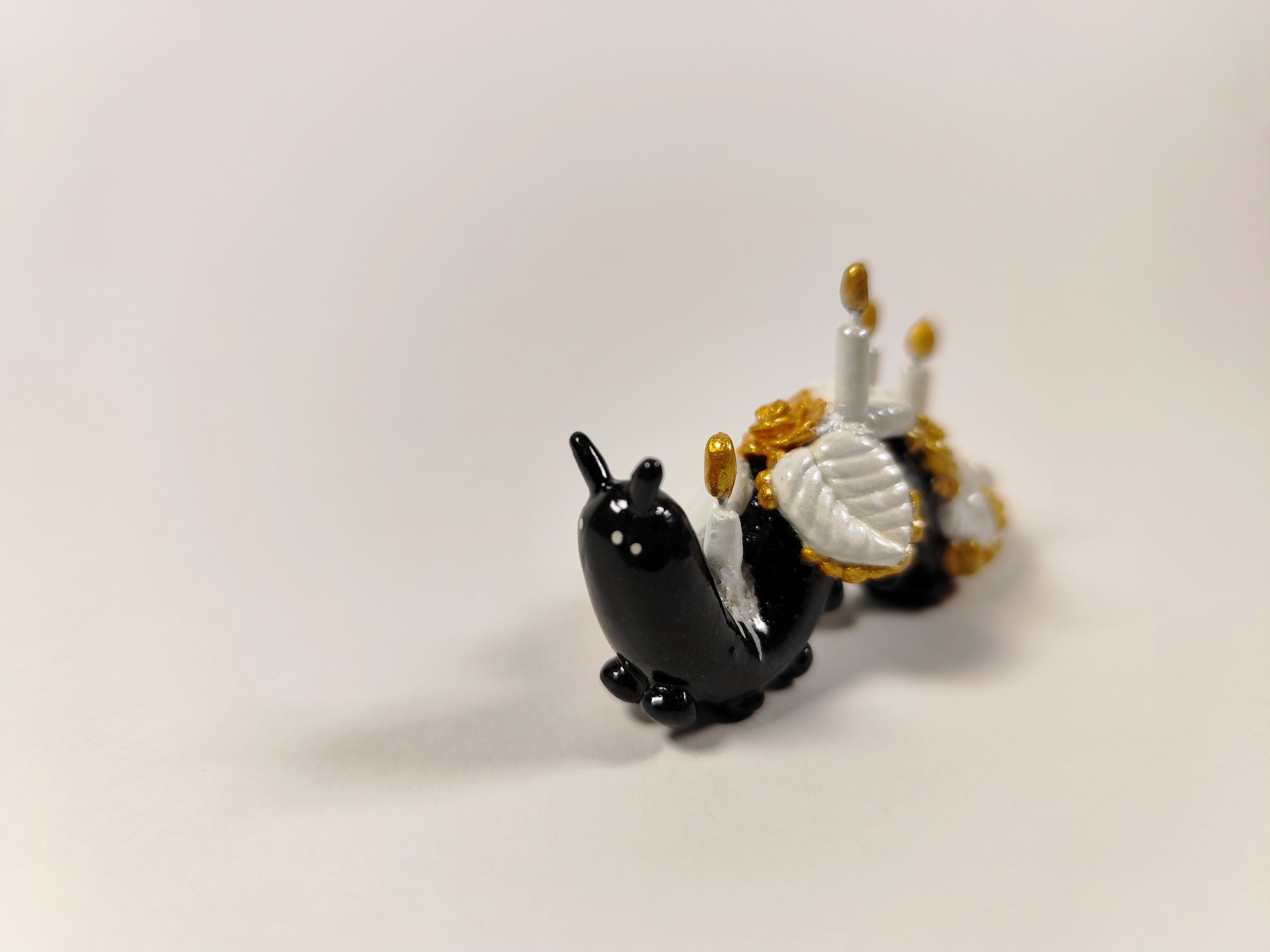
"In the stillness of a moving altar, humble matter becomes a sanctuary.
Upon her body and skin, the mother transports the gold of the world's origin.
Unhurriedly, cradling the unborn in a ritual of protection and silence that has existed since the dawn of sentient beings."
The Living Sanctuary of Maternity
Conceptual Rationale and Proposition
I. The Economy of Chthonic Continuity and the Disarticulation of Care
Utilizing an arched biological figure to articulate the concept of shelter disrupts traditional iconographic conventions of protection. In the history of forms and cultural anthropology, the larva and caterpillar encode the liminal state of metamorphosis: a transition wherein matter recedes to reorganize its internal structures. Within cosmologies tied to subterranean dynamics, these entities are associated not with insignificance, but with the engine of telluric regeneration tasked with processing organic strata to enable fertility. The dark, reflective surface catches ambient light, establishing a tactile boundary that imparts gravitational weight to the volume. Four white eyes establish a point of visual contact with the exterior. The piece functions as a mobile altar, a bodily support transporting a complex sign system upon its spine, assimilating the historiographical archetype of the Magna Mater in its purely terrestrial dimension of material resistance.
II. Botanical Symbiosis and Receptacles of Latent Potency
The white leaves fold over the profile of the work, creating a physical basin that shelters the central elements of the composition. This hybridization between animal anatomy and flora articulates an ecocentric vision of organic interdependence, where the body serves as a direct substrate for vegetation. At the center of the horizontal axis, golden roses function as visual anchors and emblems of the Magnum Opus or the development of mature form. Around them, golden eggs adhere to the skin and stems, acting as a reservoir of latent forms dependent upon the stability of their support for survival.
III. The Cosmic Egg and the Decoding of Internal Value
The golden-finished eggs distributed along the periphery of the botanical mantle appeal to the universal archetype of origin and biological promise. In ancient thought, the egg constitutes the container of immanent power, the enclosed space where form organizes in isolation prior to public manifestation. This iconography finds its historiographical counterpart in Eastern cosmogonic myths, specifically the Vedic concept of Hiranyagarbha, the golden womb floating in indeterminate space as the regulatory principle of primordial order. The sculpture absorbs this imagery of latency and translates it into contemporary three-dimensionality, presenting the eggs as pure, incorruptible cores safeguarded upon the work's surface.
This peripheral configuration further executes an analytical revision of moral structures in mass-culture folklore, such as the traditional fable of the goose that laid the golden eggs. In literary anthropology, this tale warns against the destructive inertia of the surroundings when the desire for immediate gratification attempts to accelerate natural production cycles. The sculpture reverses the outcome of this classic narrative by affixing core values directly onto a living organism that safeguards them through its own anatomy and a barrier of structural elements. The symbolic richness of the piece rests upon respect for the organic timeframe of maturation, converting the caterpillar's back into an ethical defense against the urgency of the external environment.
IV. Luminary Quaternary and Wax as a Temporal Record
The modeling captures with precision the runoff of white wax melting over dark skin. This detail introduces a physical record of temporality onto the object, fixing within the immobility of matter the illusion of active combustion. The candles supply vertical illumination contrasting with the horizontal displacement of the body, establishing a tension between the lightness of sculpted fire and the terrestrial density of the base. In gestalt psychology, the quaternary structure embodies the archetype of stability and logical order. By articulating the luminary focal point through four vectors, the work constructs a self-referential lighting system that imparts formal warmth to the golden eggs, marking the evolutionary transition between suspension or chrysalis and the emergence of a differentiated consciousness. The spilled wax acts as a memento mori of luminous matter, a material trace bearing witness to the concentrated attention essential for processes of intellectual gestation to complete their cycle without disruption from external currents.
V. The Polyocular Gaze and the Distributed Attention Network
The presence of four fixed eyes in the cephalic region complements the quaternary configuration of the candles. This proliferation of visual organs decentralizes the single focal point characteristic of traditional perspective, proposing a multiple optical capture system. The fourfold gaze operates as an endogenous surveillance network and distributed attention system charged with monitoring perceptual thresholds within the exhibition space. This anatomical resolution engages in direct dialogue with the anthropology of the visual symbol, where multiplied eyes ensure direct apprehension of the entire environment. The classical referent is found in Argus Panoptes, the hundred-eyed watchman whose capacity for perpetual vigilance was transmuted by ancient iconography into a decorative display of pure contemplation. In the sculpture, the eyes function as a protective device focused on preserving the dorsal payload, guaranteeing the inviolability of the ritual space against the disintegrating forces of external dispersion.
VI. The Lineage of Custody in Mass Visual Culture
This dynamic of segmented entities tasked with protecting the germ of continuity finds resonance in contemporary entertainment and mass visual culture repertoires, demonstrating the persistence of long-standing archetypes across current media platforms. At the extreme of hostile biomechanical design, the cinematography of the Alien Queen in contemporary science fiction presents a version of the chthonic matrix whose physiognomy is focused on the relentless preservation of its gestational cores. Conversely, in avant-garde Japanese animation narratives, the figure of the Mothra larva embodies the strength of an organism assuming custody of a giant golden egg as a bulwark against global destruction. In parallel, within interactive media and video games, the iconography of the deity Alexstrasza in the World of Warcraft universe codes igneous energy not as a tool of destruction, but as a protective vector securing the birth of new structures governing environmental balance.
VII. Phenomenology of Light and Perceptual Suspension in the Digital Era
In the contemporary era, where luminary experience and information flow are dominated by the constant glare of digital screens, cold temperature emissions, and algorithms quantifying imagery in real time, the piece introduces a physical manifestation of light anchored in the density of the sculpted sign. The work positions itself as a critical interruption to the immateriality and acceleration of current mass culture. By condensing combustion cycles and origin imaginaries into an intimate, studio-scale object, the sculpture forces a deceleration of the viewer's transit. The material contrast between the dark body and the chromatic purity of the white leaves and golden eggs establishes the three-dimensional object as a space of visual resistance that restores to the spectator the consciousness of the act of seeing, transforming the evocative gesture of care into a device for silent contemplation and introspection within today's visual landscape; the vulnerability of embryonic states constitutes a phase of maximum symbolic concentration and protective silence.