
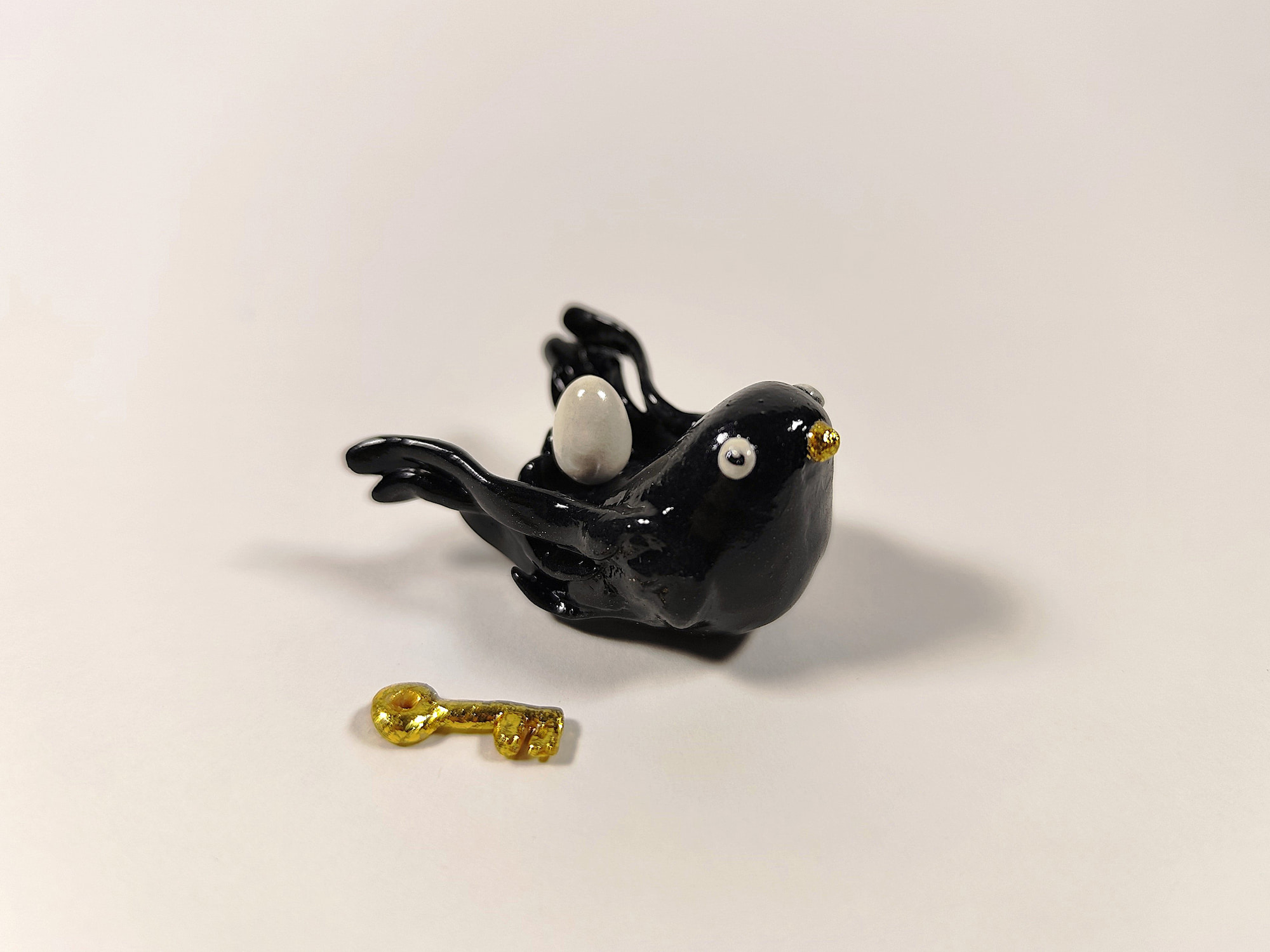
The Mother of Black Wings
Blanca de la Torre
polymer medium, composition gold leaf, and acrylic paint.
Two-piece installation. Piece 1: 2.5 x 3 x 4.5 cm; Piece 2: 0.2 x 1.6x 0.6 cm.
2026




"There are processes that mature only within the silence of the intimate.
In a world drunk on immediate light, a mother of dark wings guards the fragility of that which must not yet be shown."
The Mother of Black Wings
Conceptual Rationale and Proposition
I. Anatomy of Containment: The Nocturnal Receptacle and the Origin
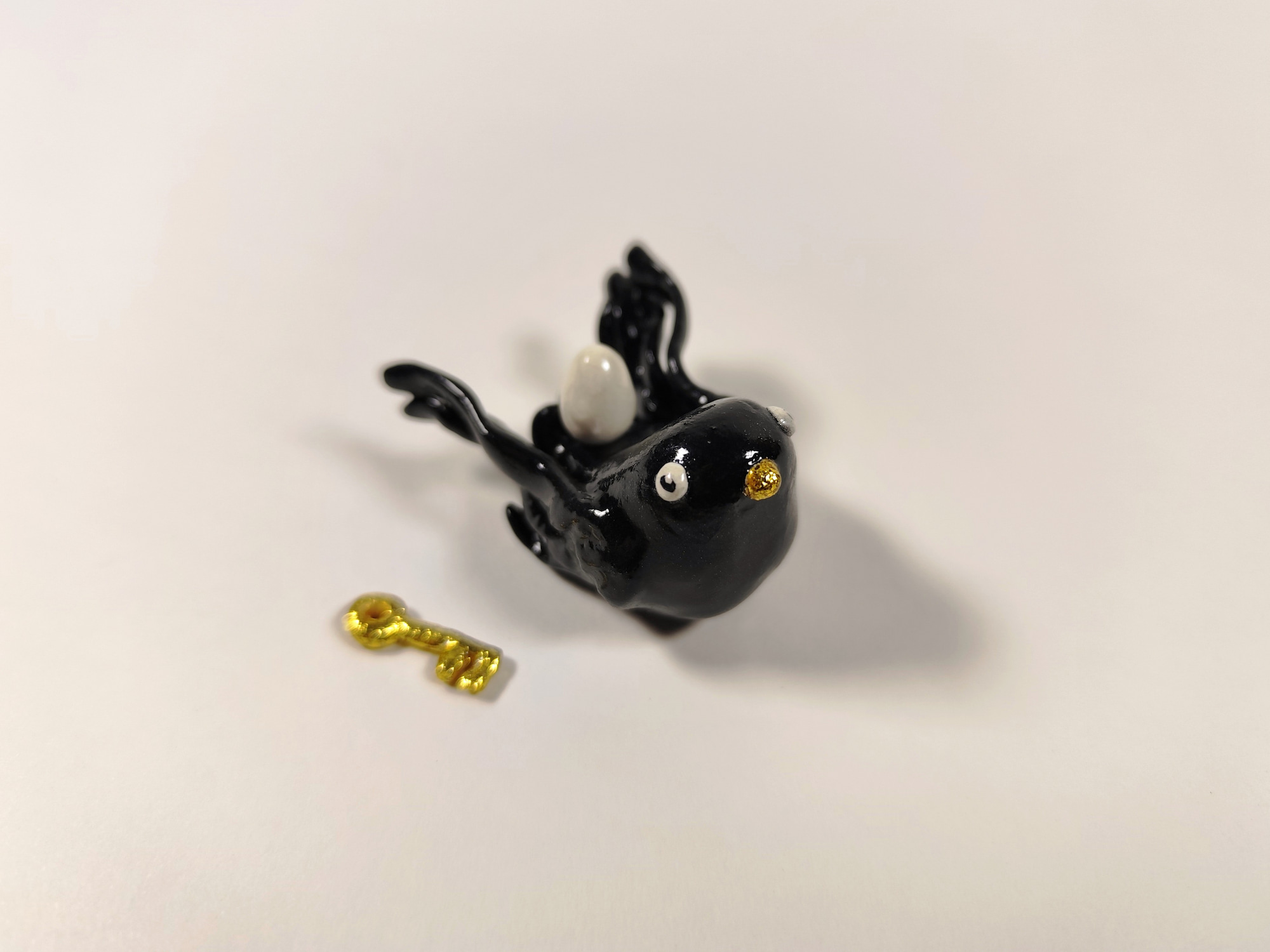
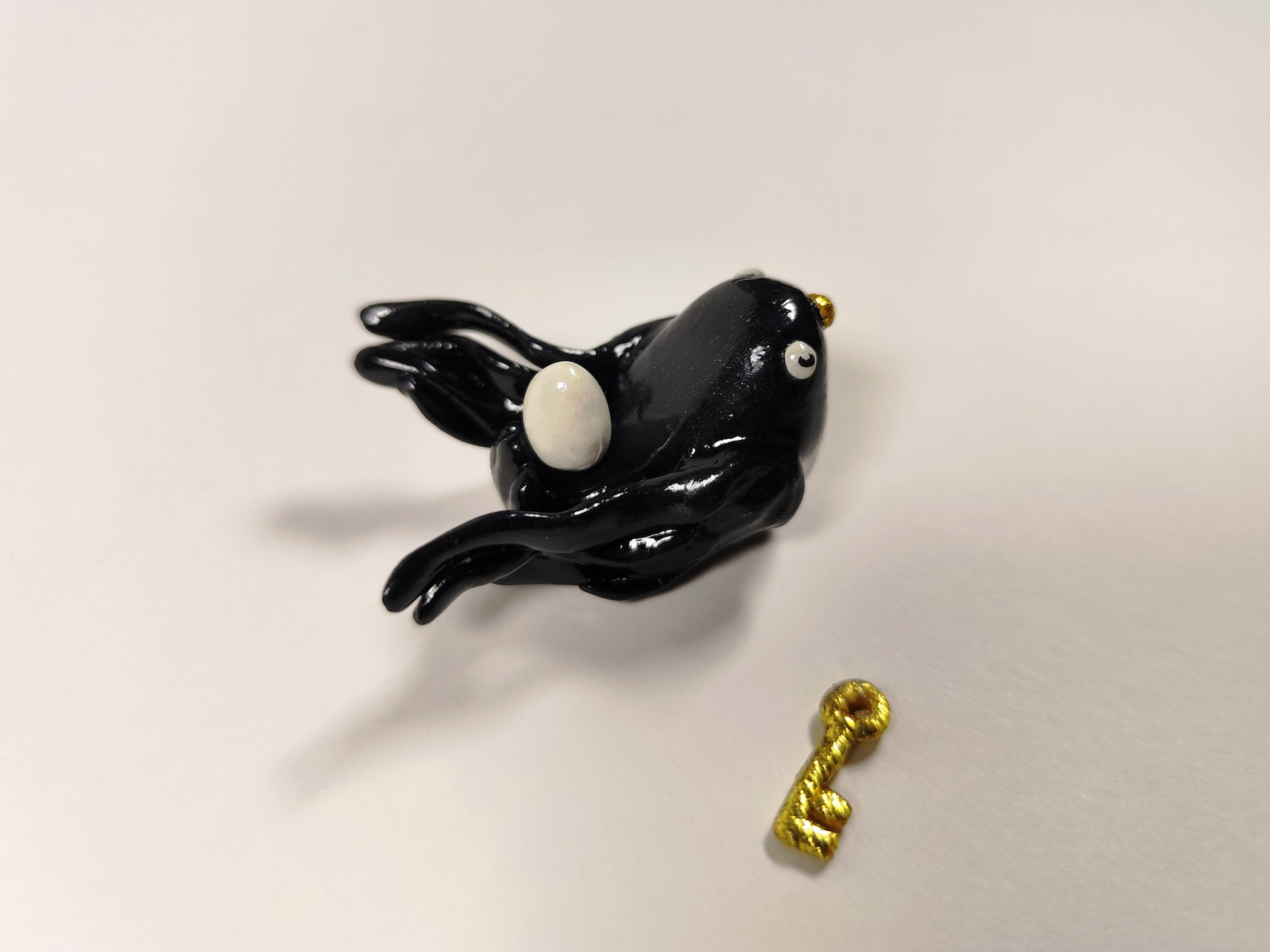
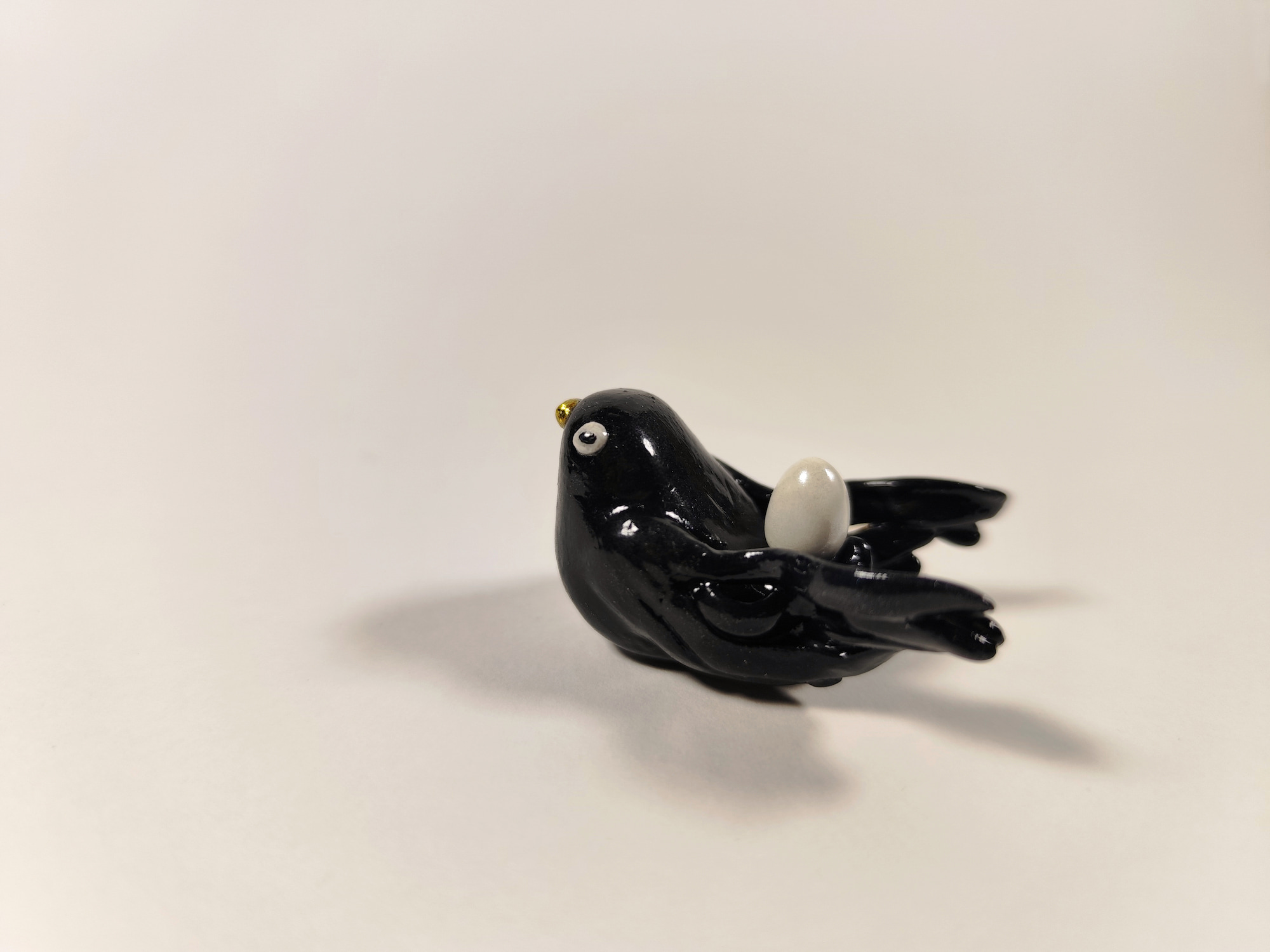
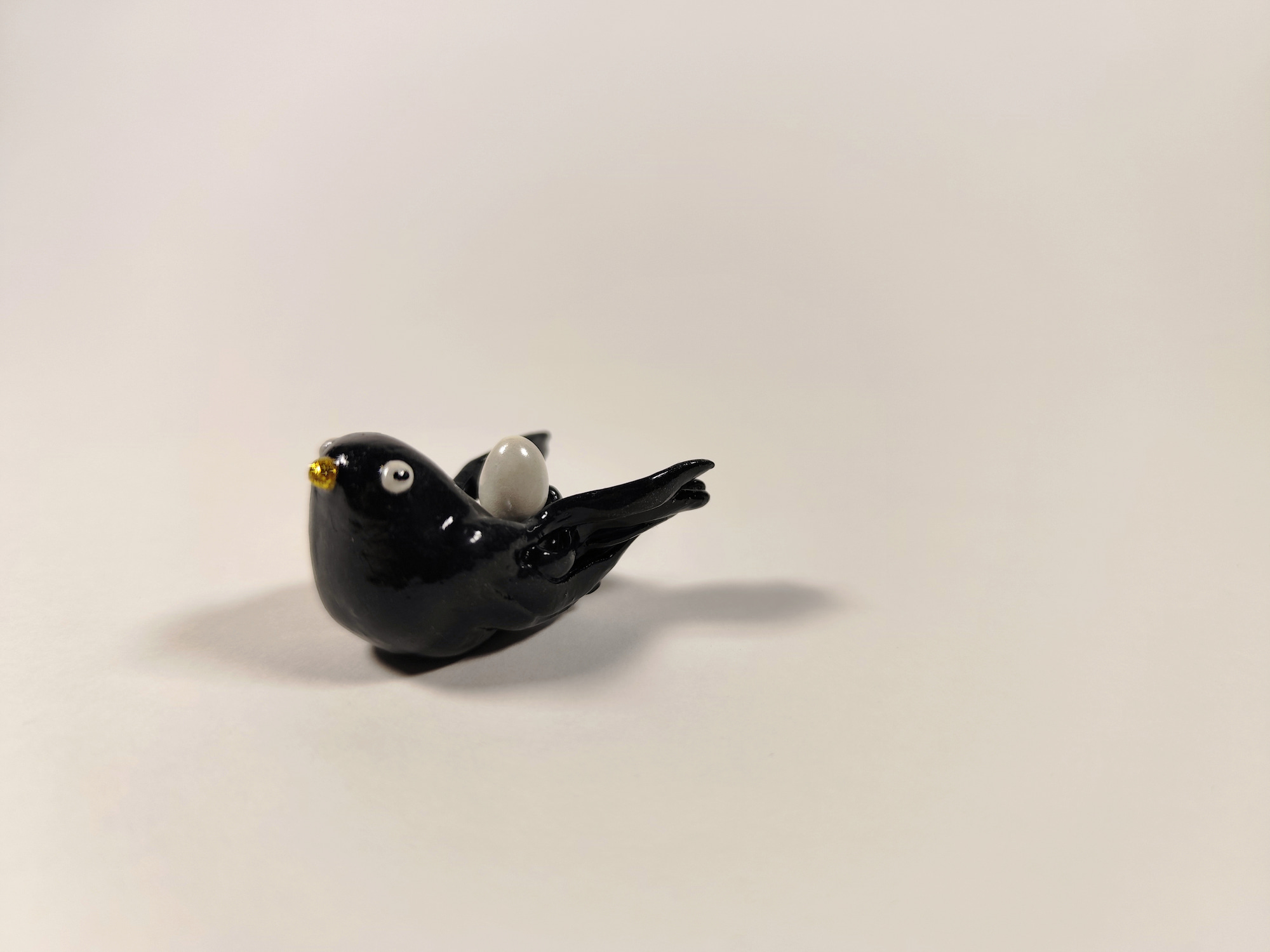
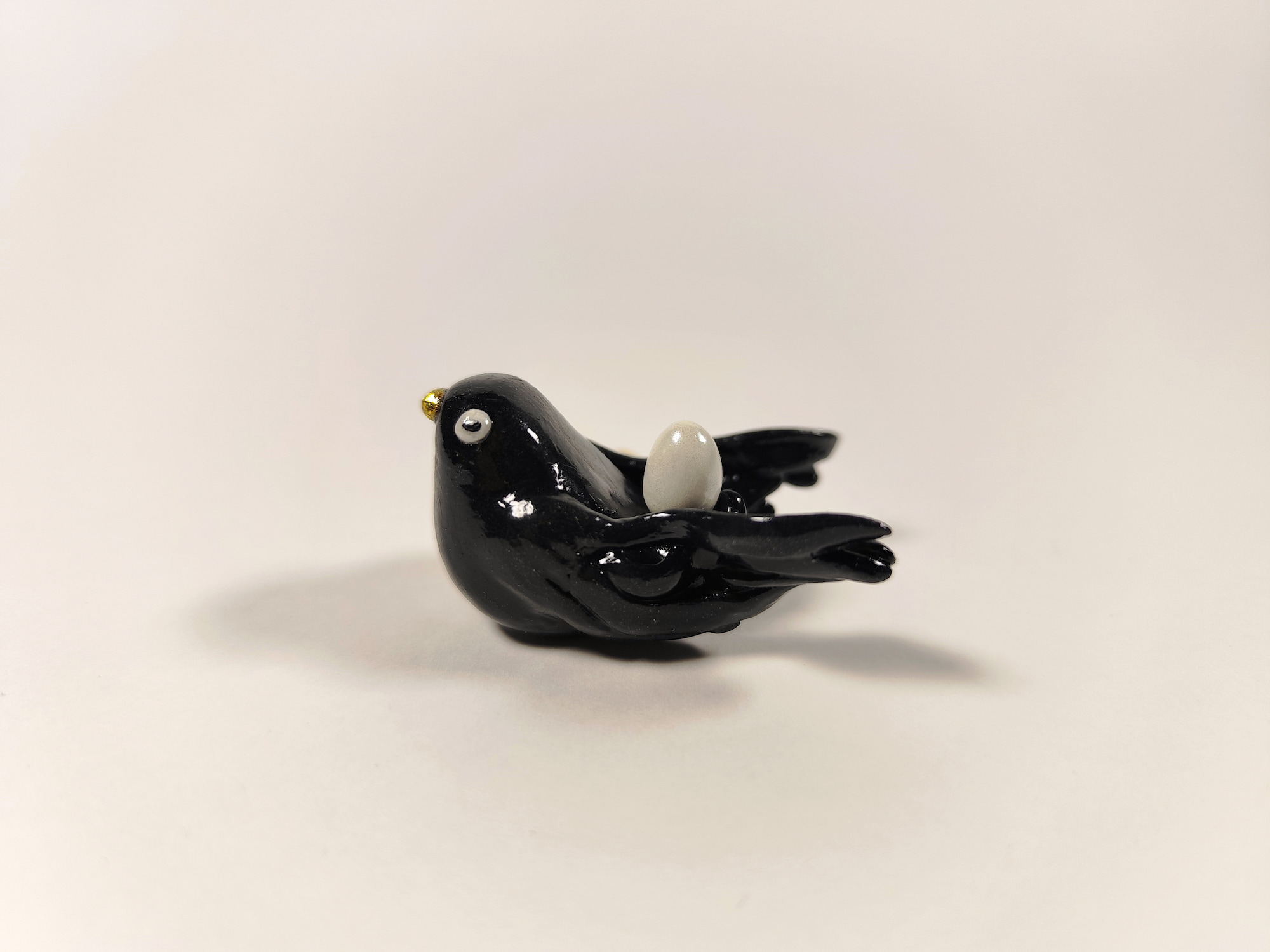
The Mother of Black Wings configures an architecture of containment through an intimate scale sculpture. The bird's anatomy, refined to its essential lines and resolved in a smooth, glossy black surface, synthesizes the animal figure with the function of the nest. Its wings, folded organically toward the torso, form an enveloping receptacle that welcomes and protects what rests inside.
This dark density connects with the tradition of great primordial matrices, such as the Egyptian goddess Nut, who spreads her wings over creation to safeguard life. Likewise, the work evokes the mythical figure of Nyx, the primordial night who in Orphic cosmogonies incubates the cosmic egg within the abyss of the indeterminate, alongside the symbolism of the Bennu bird and traditions where the ordering principle emerges from a space of shadow. The sculpture materializes this space as a center of active protection, where the dark mass functions as a mantle preserving the delicate before its public manifestation.
II. Silent Gestation: The Egg and Immanent Power
In the bird's dorsal cavity, supported by the curvature of the wings and back, rests a single white-surfaced egg. The clear chromatic opposition between the maternal structure and the bright sphere of the central element establishes a direct contrast between container and contained, between protective mass and developing form.
The egg embodies the universal archetype of latency and biological promise: a vessel of potentiality where form organizes itself in silence before revealing itself to the outside world. From cultural anthropology, the incubation phase represents the liminal state theorized by Arnold van Gennep: a time of suspension where the deepest transformations occur away from the public gaze. The work articulates this concept of deferred time as an indispensable process for the maturation of any organism, notion, or symbolic structure.
III. The Golden Key: Access Technologies and the Transmission of Meaning
Positioned adjacently on the same surface, independent of the main volume, lies a small key with a golden finish. Its presence introduces a contrast between the corporeality of the winged body and the functional precision of the metallic object.
From archaic symbolism, the key articulates the passage between the reserved and the public, functioning as the attribute of the Mesopotamian deity Inanna in her transitions between realms or of the guardians of ancient temples. The golden color endows the object with a value of permanence and hierarchy. Positioned in front of the bird, the key formalizes the threshold protocol: it activates the viewer's agency and establishes that access to knowledge requires conscious mediation and a willingness to decipher.
Likewise, the presence of the golden key dialogues directly with the reality of contemporary access technologies. In a world where authentication has become immaterial through passwords, biometric recognition, and digital credentials, the sculpture reintroduces the physical object as a tangible interface. The work demonstrates that the dynamics of protection, privacy, and information disclosure are not recent inventions, but the evolution of archaic custody structures that contemporary society continues to reformulate.
IV. Archetypology of the Chthonic Mother and the Anthropology of Care: The Ethics of Interdependence
The bird's upright posture, golden beak, and clear forward gaze establish it as an embodiment of the Great Chthonic Mother, the earthly matrix guarding the processes of regeneration and developing life. The sculpture articulates the act of care as an active, conscious stance of firm protection against the external environment.
Within contemporary anthropology, this maternal and earthly figure connects with current discussions on the care economy, biopolitical sustainability, and collective responsibility. The work maintains that attending to the fragile is neither a passive gesture nor a secondary concession, but the foundation of an ethics of interdependence. Opposing the modern myth of individual self-sufficiency, the sculpture reveals the web of relations that sustains life: the egg relies on the bird's containment, while the maternal form fulfills its purpose in safeguarding nascent potential. Extrapolating this dynamic to social reality, the piece posits vulnerability as a shared condition. Caring for the fragile thus transforms into an indispensable ethical and political imperative for preserving community, emotional, and environmental bonds.
V. Symbolism and Reality in Contemporary Society: The Politics of the Intimate and the Sanctuary Space
In today's society, dominated by media overexposure, algorithmic data transmission, and the demand for immediate transparency, The Mother of Black Wings acquires direct critical resonance. The work contrasts the speed of digital consumption with the intrinsic slowness of gestation processes. The dark cavity protecting the white egg prompts reflection on the loss of private spaces in the contemporary era, affirming the need to preserve zones of opacity where ideas, identities, and affections can develop before being exposed to the market or public evaluation.
Intimacy is revealed here as an essential ontological condition for the constitution of the subject and the gestation of complex thought. In a hyper-connected ecosystem that commodifies private experience and transforms attention into a constant metric, the unexposed space operates as an epistemic sanctuary. Premature overexposure erodes the possibility of maturation: that which is displayed ahead of time risks withering or being co-opted by external pressures. In this sense, the black mass enveloping the egg acts as a defensive and ethical architecture, a reminder that genuine creative, political, and emotional autonomy requires an inviolable domain where the individual and the collective retain the right to secrecy, pause, and incubation away from the demands of mandatory visibility.
VI. Iconographic Evolution and Matrix of Meaning
The volumetric treatment of the piece and the interaction between its components demonstrate the vitality of symbolic languages in contemporary visual culture. The sculpture consolidates a convergence space between mythical memory and current sensitivity, showing that ancient archetypes do not belong to the past, but migrate into new forms to answer the questions of the present.
The Mother of Black Wings acts as a contemporary totem that condenses the fundamental pursuits of current society through a refined formal synthesis. By linking the logic of incubation, the pedagogy of care, and the responsibility of access, the work reaffirms the organic continuity of art history, where each era reformulates the tools of myth to endow human experience with meaning.